
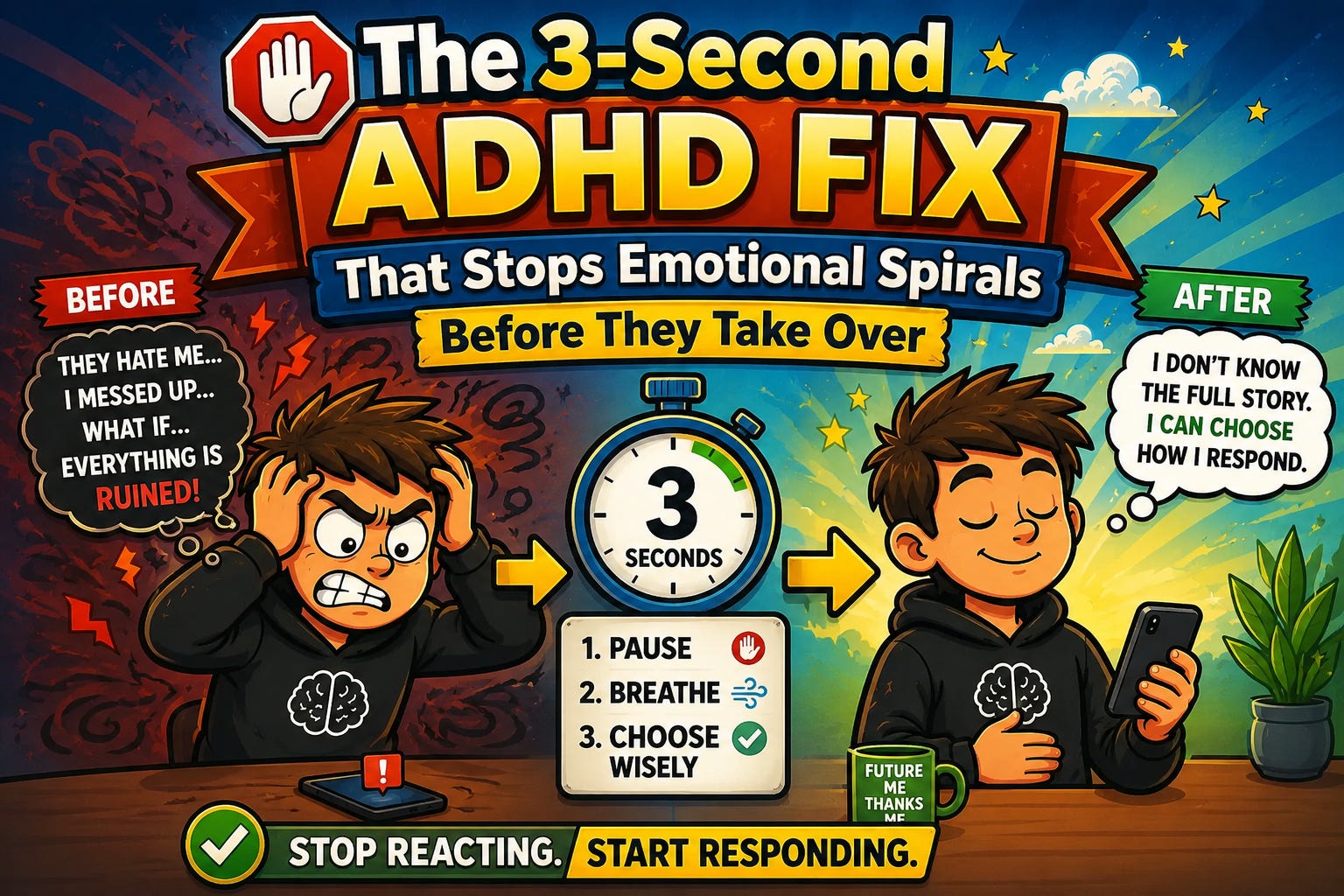
🛑 The 3-Second ADHD Fix That Stops Emotional Spirals Before They Take Over
A science-backed pause that helps you avoid regret, reduce overthinking and stay in control when emotions hit hard

😔 The ADHD Moment We All Know
Have you ever sent a text you immediately regretted?
Or spent hours feeling upset about something that, the next day, didn’t even matter?
I have.
And if you have ADHD, chances are you know this pattern too. Someone says something that feels critical. A friend doesn’t reply. Your boss gives feedback.
A partner sounds slightly annoyed. And suddenly your brain isn’t processing a comment anymore. It’s processing a threat. Within seconds, RSD kicks in and your thoughts start racing:
💭 “They’re upset with me.”
💭 “I messed up again.”
💭 “They’re disappointed.”
💭 “I should explain myself.”
💭 “I need to fix this NOW.”
Before you know it, you’re defending yourself, overthinking, doom-scrolling, sending messages or replaying the situation in your head for hours.
The hardest part?
Most of the time, the emotional reaction happens so fast that it feels automatic. Like your brain hit “Send” before you had a chance to read the message. For years, I thought this was just who I was.
Then I discovered something surprisingly powerful: A pause.
Not a 10-minute meditation. Not a complicated productivity system.
Just 3 seconds. And those 3 seconds started changing everything.
🧠 Why ADHD Emotional Spirals Happen
Most people think ADHD is an attention disorder. But many ADHD experts argue that ADHD is actually a self-regulation disorder. Attention is only one part of the story. Emotional regulation is another.
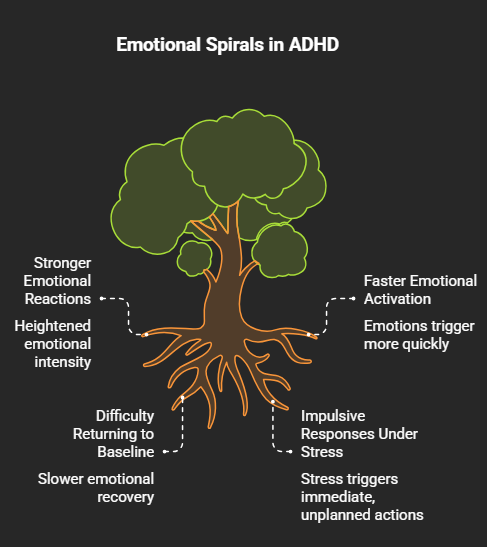
Research shows that people with ADHD often experience:
✅ Stronger emotional reactions
✅ Faster emotional activation
✅ Greater difficulty returning to baseline
✅ More impulsive responses under stress
Dr. Russell Barkley, one of the world’s leading ADHD researchers, has long described emotional self-regulation as a core part of ADHD, not merely a side effect.
Scientific resources:
🔗 https://www.ncbi.nlm.nih.gov/pmc/articles/PMC4282137/
🔗 https://www.additudemag.com/emotional-regulation-adhd/
This means that your brain isn’t broken. It’s reacting before your executive functions have enough time to engage.
⚡ Why The 3-Second Pause Works
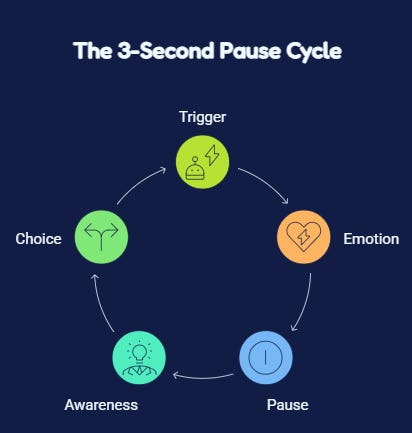
The pause works because it creates space between:
Trigger ➜ Reaction and Trigger ➜ Choice
When we’re emotionally activated, the brain’s emotional networks are driving the bus. The pause gives executive functions a chance to catch up.
Think of it this way:
Without the pause: Comment → Emotion → Reaction
With the pause: Comment → Emotion → Pause → Awareness → Choice
Your aim is to move from Reaction to Choice
The emotion still exists. But now you have options and options change outcomes.
🔥 Before vs After The Pause
BEFORE
Partner: “Can we talk later?”
ADHD Brain:
❌ They’re upset. ❌ I did something wrong.
❌ The relationship is in trouble. ❌ I need to fix this now.
Result: Hours of anxiety. Overthinking. Stress. Lost focus.
AFTER
Partner: “Can we talk later?”
Pause 1... 2... 3...
Question: “What evidence do I actually have?”
Answer: None
Result: Less anxiety. More clarity. Energy saved. Focus protected.
Same situation. Different outcome.
🚦 The 3-Second ADHD Pause Method
The next time you feel emotionally activated:
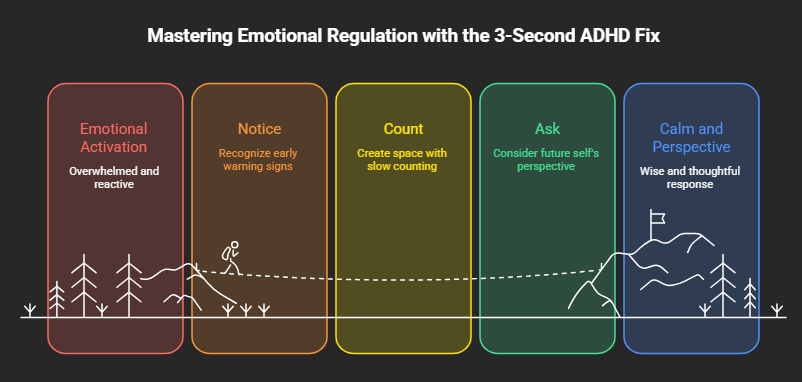
Step 1: Notice
Look for early warning signs:
⚠️ Tight chest
⚠️ Racing thoughts
⚠️ Urge to defend yourself
⚠️ Feeling misunderstood
⚠️ Rejection sensitivity (RSD)
⚠️ Desire to respond immediately
Step 2: Count
Slowly count: 1... 2.. 3...
Nothing else. No analysis. No problem solving. Just create space.
Step 3: Ask One Question
Ask:
“What response will Future Me thank me for?”
This is my favorite ADHD question because it bypasses emotion and activates perspective. Future Me is usually wiser than Emotional Me.
🎯 What The Pause Is Really Doing
Many ADHDers think they need better self-control. But often what we really need is more reaction time.
The pause gives us:
✅ Time to think
✅ Time to gather evidence
✅ Time to calm the nervous system
✅ Time to interrupt catastrophic thinking
✅ Time to choose instead of react
Three seconds may seem small. But emotional spirals often begin in less than three seconds.
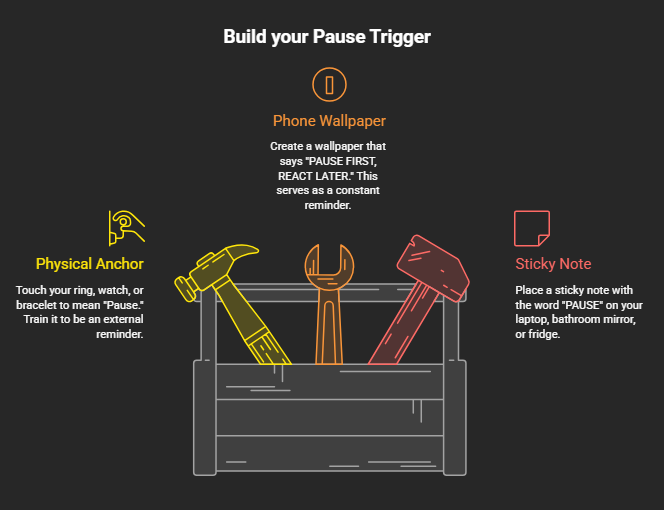
🛠️ Build A “Pause Trigger”
Don’t rely on memory.
ADHD brains aren’t great at remembering strategies during emotional moments. Instead, create external reminders.
💍 Physical Anchor
Touch your ring. Touch your watch. Touch your bracelet.
Train it to mean: “Pause.”
📱 Phone Wallpaper
Create a wallpaper that says:
PAUSE FIRST , REACT LATER
📝 Sticky Note
Place one on:
Laptop
Bathroom mirror
Fridge
One word: PAUSE That’s enough.
📋 ADHD Emotional Spiral Cheat Sheet
Screenshot this.
When Triggered:
✅ Stop
✅ Count 1-2-3
✅ Breathe once
✅ Ask: “What evidence do I have?”
✅ Ask: “What would Future Me do?”
✅ Wait before sending
Avoid:
❌ Immediate texting ❌ Defending yourself instantly
❌ Making major decisions ❌ Assuming the worst
❌ Mind reading ❌ Catastrophizing
🚀 Your Challenge Today
For the next 24 hours every time you feel emotionally activated:
1️⃣ Stop
2️⃣ Count to three
3️⃣ Ask:
“What response will Future Me thank me for?”
That’s it. No app. No expensive course. No complicated system.
Just three seconds
Three seconds that can save hours of stress.
Three seconds that can prevent arguments.
Three seconds that can protect relationships.
Three seconds that can change the direction of your day.
💬 Final Thought
One of the biggest ADHD myths is that emotional reactions are uncontrollable.
They’re not. They’re fast. And fast things require space. The 3-second pause isn’t about becoming calmer. It’s about creating enough space for your wisdom to catch up with your emotions. And sometimes... that’s all you need.
💙 If This Helped You...
Have you ever experienced an ADHD emotional spiral?
What triggered it? What helps you pause before reacting?
👇 Share your experience in the comments.
Someone else might need to hear it today.
If you found this useful ❤️ like this post
🔄 Share it with a fellow ADHDer
📩 Subscribe to ADHD Wisdom Tools for practical ADHD strategies, tools, and insights that actually work in real life.
Because ADHD is hard enough. Let’s make it easier together.
📚 Resources & Further Reading
ADHD & Emotional Regulation
Books
📖 Your Brain’s Not Broken — Tamara Rosier
📖 Driven to Distraction — Edward Hallowell & John Ratey
📖 The ADHD Effect on Marriage — Melissa Orlov
📖 The Dialectical Behavior Therapy (DBT) Skills Workbook — McKay, Wood & Brantley
Helpful Practices
✅ Mindfulness
✅ CBT
✅ DBT Emotional Regulation Skills
✅ Exercise
✅ Sleep Optimization
✅ Trigger Journaling


Great, this might help too:
https://substack.com/@yinyangbrain/note/c-272794164
❤️🔥❤️🔥❤️🔥 this post is spot on for me! your articles are so incredibly well researched and written. you’re creating an incredible resource for neurodivergent folks here and i appreciate you!
i genuinely read your articles and try the suggestions. the Finch app has truly helped me so much.
i remember a shorter article that discussed a technique similar to what you share in such incredible detail here. i’d like to share a personal experience with that:
this week my partner was injured and was feeling much more emotional than usual but i was oblivious to his heightened vulnerability. he inadvertently said something that triggered a memory from a very controlling relationship in college. i felt the immediate and visceral distress that accompanies any interaction that feels controlling.
(i have that genx “i won’t do what you told me” style of reaction to coercion or control which i now know is also common with adhd because you wrote an article!!!)
as i was feeling my body react and the thoughts start to spin, i was trying to untangle my wired headphones so that physical struggle added to my distress. my partner immediately sensed a problem and asked what was wrong. i didn’t snap at him or try to continue what i was doing. i just paused and took a deep breath and said “just hang on ok?”. i took several more breaths and changed my tactics with the headphones which fixed that problem. i then was able to gather my thoughts and calmly explain how his completely innocuous and reasonable comment triggered a memory i didn’t know was still upsetting.
it ended up being a bit of a bonding experience because i never had to get through the remorse for my overreaction. so i absolutely can confirm that the suggestions in this article can help in everyday situations. 🫶🫶🫶