
🔥 Your Desk Is Draining Your Brain (Here’s How to Fix It)
How to build an ADHD-friendly workspace that protects your focus, reduces overwhelm, and actually works with your executive function

Q from a reader:
“Anything you can share on executive function and desk/office organizing would be great.”
YES. Because for ADHD brains, your desk isn’t just furniture.
It’s either:
A support system
Or a silent cognitive tax
Let’s remove the tax.
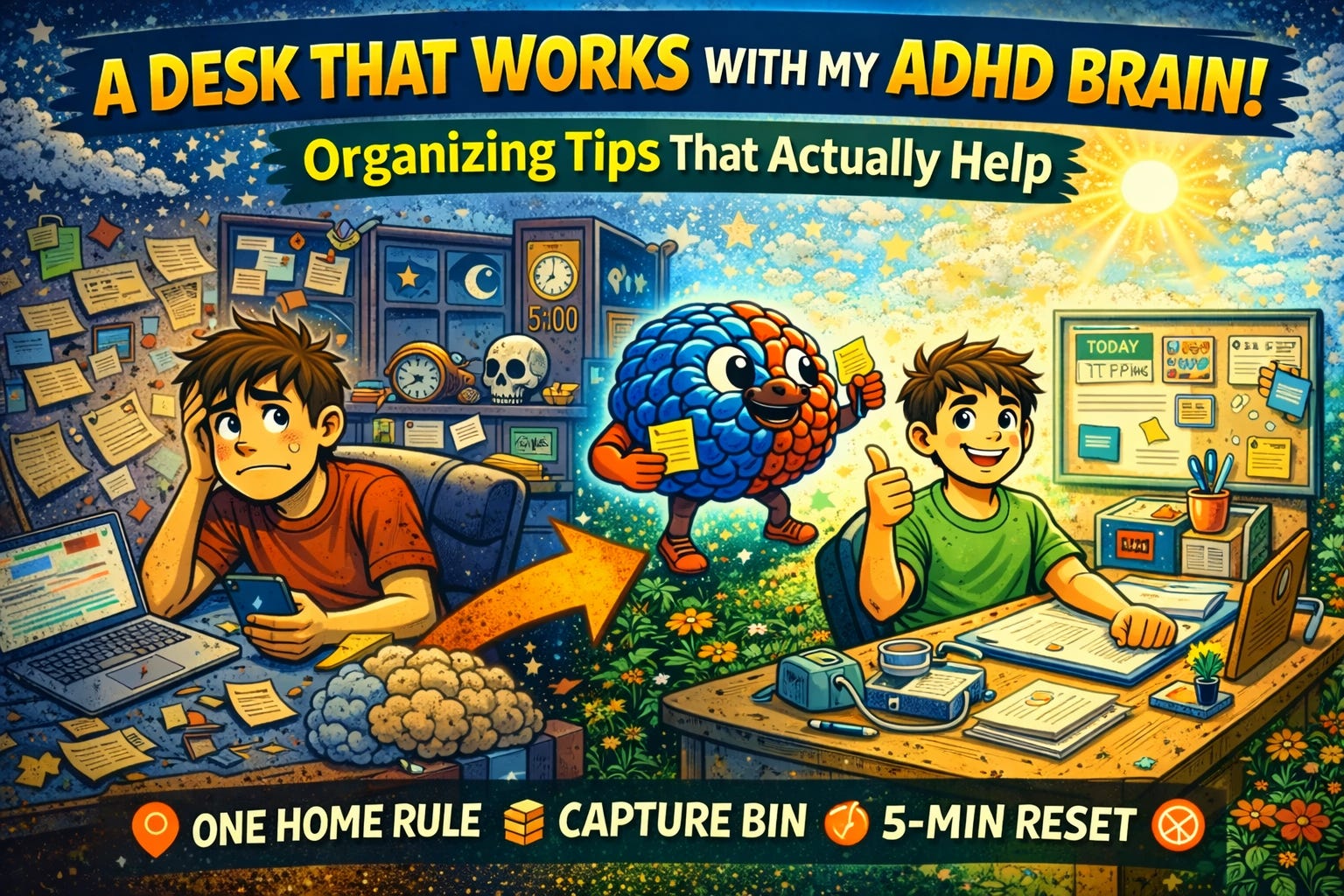
🧠 What You’ll Learn
By the end of this, you’ll know:
✔ Why mess feels heavier with ADHD
✔ Why most organizing systems fail ADHD brains
✔ The One-Home Rule that reduces decision fatigue
✔ How to build external executive scaffolding
✔ A simple 5-minute reset ritual that protects tomorrow’s focus
✔ What an ADHD-supported desk actually looks like (Before → After)
🧠 What’s Really Happening
(Executive Function + ADHD)
Executive function is your brain’s management system.
It handles:
Planning
Organizing
Task initiation
Prioritizing
Working memory
Self-monitoring
These functions are largely coordinated by networks involving the prefrontal cortex (the brain’s “CEO”) and its connections with other regions (Diamond, 2013).
With ADHD, this system doesn’t self-organize smoothly.
Not because you’re lazy.
Not because you lack discipline.
But because internal structure is not automatic.
Research consistently shows ADHD is associated with differences in:
Working memory
Inhibitory control
Planning ability
Sustained attention
Which means:
👉 You don’t need better willpower.
👉 You need better external structure.
That’s not weakness.
That’s neurodesign.
🧩 ADHD Desk Organizing — The Brain-Friendly Way
Most organizing advice assumes:
“You’ll just remember where things go.”
ADHD brains don’t work like that. So we build for behavior, not fantasy.
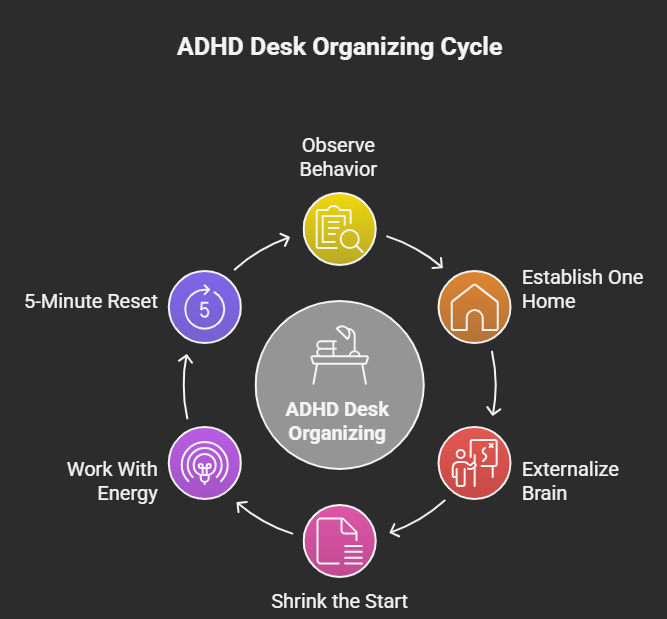
🔹 1 — Start With Behavior (Not Aesthetic Systems)
Before changing anything, observe:
Where do pens naturally land?
Where do you instinctively look first?
Where do things vanish?
Design around what you already do automatically.
If pens always land near your laptop —
that’s their home now.
Not the “beautiful drawer system” you forget exists.
🔹 2 — The One-Home Rule (Massive Cognitive Relief)
Everything gets ONE place. Not two.
Not “somewhere around here.” One.
Why? Because ADHD working memory hates uncertainty.
When an item has one home:
You stop scanning
You stop guessing
You stop burning energy
Less friction = more focus available for actual work.
🔹 3 — Externalize Your Brain
Your internal reminder system is inconsistent. So move it outside your head.
Use:
📌 Sticky notes in your line of sight
📌 A mini whiteboard (max 3 priorities)
📌 A timer / Pomodoro app
These aren’t productivity hacks.
They’re executive function supports.
Think prosthetics — not tricks.
🔹 4 — Shrink the Start (Momentum > Motivation)
“Organize the desk” is too abstract.
Instead:
Clear just one corner
Put loose paper in ONE bin
Remove visible trash
10 minutes. That’s it.
ADHD momentum builds from completion, not intention.
🔹 5 — Work With Energy, Not the Clock
ADHD brains are interest- and energy-driven, not time-driven.
Notice:
When does clarity peak?
When does medication activate?
When does focus feel easier?
That’s your organizing window.
Not 9am just because it sounds productive.
🔹 6 — The 5-Minute Reset That Changes Everything
At the end of each workday:
⏱ 5-minute timer
✔ Return items home
✔ Clear surface
✔ Remove cups/trash
You’re not creating perfection. You’re protecting tomorrow’s executive function.
🔄 BEFORE vs AFTER
❌ BEFORE (Unsupported ADHD Desk)
Multiple “temporary” homes
Paper stacks everywhere
Visual clutter in direct line of sight
Constant micro-stress
Brain scanning instead of starting
Result:*
Decision fatigue before work even begins.
✅ AFTER (ADHD-Supported Desk)
One-home rule in place
Visible area = current priorities only
Loose paper has a capture bin
Daily 5-min reset
Calm visual field
Result:
Cognitive bandwidth preserved. You sit down — and start.
No negotiation with chaos.
💛 Reality Check
If your desk explodes quickly… That’s not failure. That’s feedback. It means your brain relies heavily on external systems. So your workspace must become part of your executive support network — not a field of visual landmines.
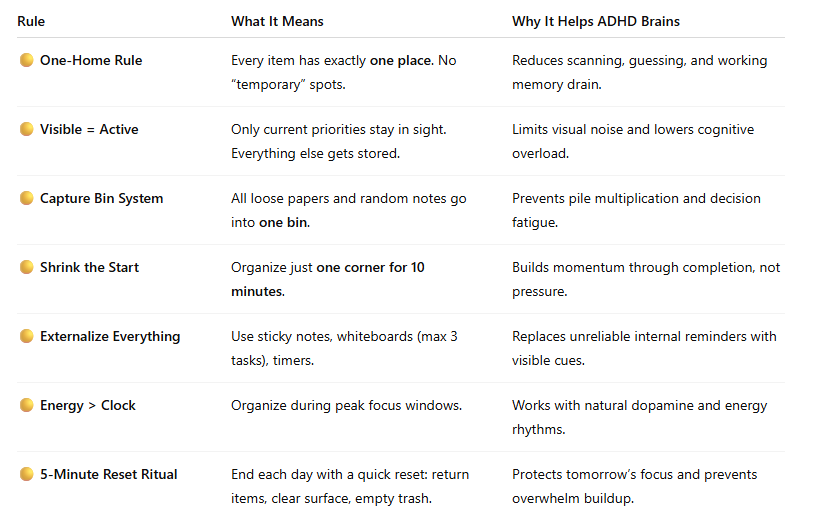
🧠 ADHD Desk Reset — Cheat Sheet
🧠 The Core Takeaway
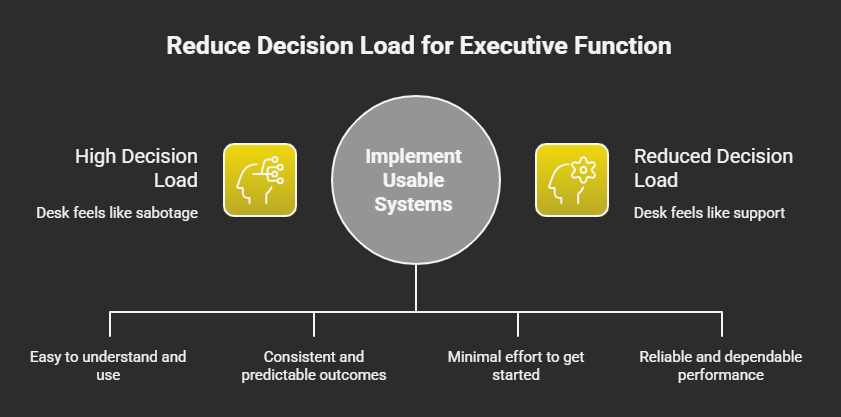
Executive function isn’t about effort. It’s about reducing decision load. Forget “perfect organizing.”
Aim for:
Usable
Repeatable
Low friction
Trustworthy
Your desk should feel like support. Not sabotage.
💛 Final Thought
ADHD isn’t a motivation problem. It’s a structure mismatch.
When your environment carries some of the executive load,
your brain is finally free to do what it does best: Think. Create. Focus.
Your desk should reduce resistance — not create it.
Support the brain you have.
Not the one productivity culture expects.
If this helped you see your desk differently,
drop a comment and tell me:
👉 What’s the one thing on your desk that causes the most friction?
Your answer might help someone else feel less alone.
And if you want more practical, science-backed ADHD tools like this:
📤 Share this with someone whose desk is secretly draining them.90/
🧠 Subscribe so you don’t miss the next one.
Let’s build environments that work with our brains.
🔗 Related Article
If this resonated, you’ll love:
🧠 Unlock Laser Focus in 30 Seconds! The ADHD productivity Hack You Need!
🚀 How to create lasting habits that create results? Start Today!
Thank you so much, Lud. I've read many of these tips several times, but the way you've explained them made them sink in in a practical way. I’m looking forward to implementing the ones I haven't yet, a little at a time, just like you suggested. I truly appreciate you taking the time to answer my question. Thanks again! ✨
Multiple notes/papers