
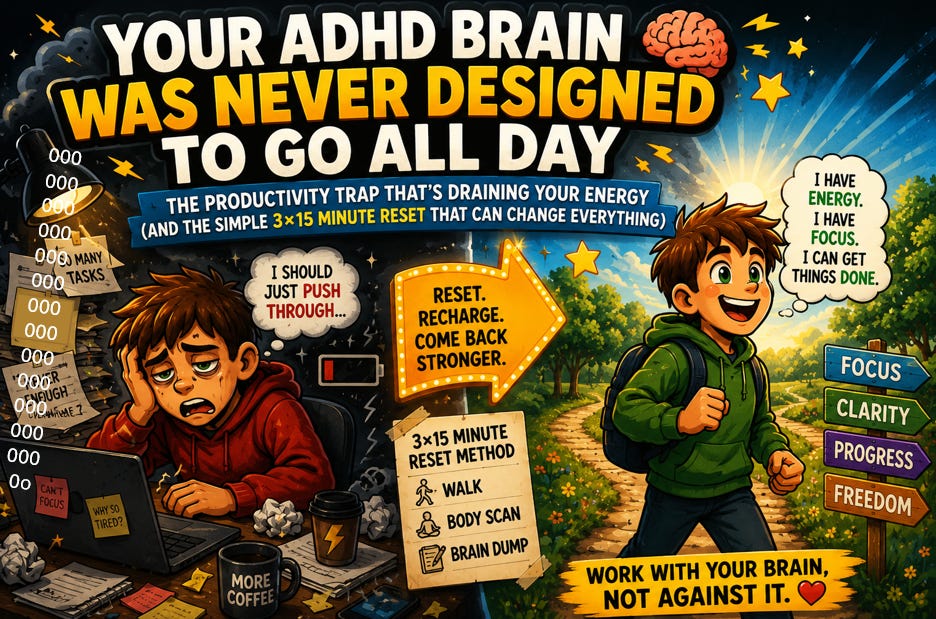
🚨 Your ADHD Brain Was Never Designed to Go All Day
The Productivity Trap That's Draining Your Energy (And the Simple 3×15 Minute Recharge MethodThat Can Change Everything)

Yesterday, I opened an email I had already read three times. I knew what I needed to do. I knew the answer. But somehow, my brain couldn’t make the next step happen.
So I did what many of us do. I made another coffee. I stayed at my desk.
I told myself: “Come on. Just focus. Push through.”
Thirty minutes later, I was still there. Same screen. Same email. Same frustration.
And that familiar question appeared: “Why can’t I just do this?”
Maybe you’ve asked yourself the same thing. Maybe you’ve had days where you worked for hours but somehow felt like you achieved nothing. You weren’t lazy.
You weren’t lacking discipline. Your brain was simply running low on fuel.
🧠 The Hidden Problem Nobody Talks About
When people talk about ADHD, they usually talk about attention. Can’t focus. Easily distracted. Too many ideas. Difficulty finishing tasks. But attention is only part of the story. A huge part of ADHD is energy management.
Because every day, your brain is doing invisible work. Trying not to check your phone. Bringing yourself back after an interruption. Starting a task that feels boring. Switching between priorities. Managing emotions when things become overwhelming.
All of these things require mental energy. And for many ADHD brains, they require more effort.
Think of two cars driving the same distance. One uses 5 liters of fuel. The other uses 10 liters. Neither car is broken. One simply needs to refuel more often.
Your ADHD brain is not broken. It just has a different fuel consumption pattern.
⚡ The Productivity Lie That Exhausts Us
Many of us grew up with the same message:
Work harder. Push through. Don’t stop until it’s finished. Rest when you’ve earned it.
But there is a problem with that idea.
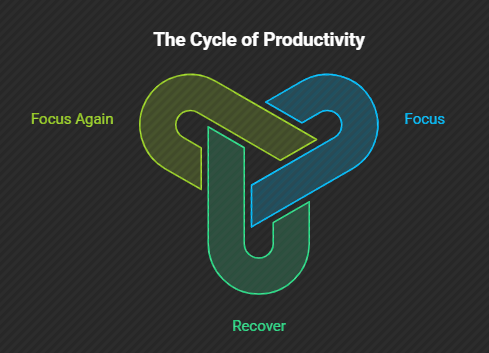
Your brain doesn’t work like a machine. It works in cycles.
Focus → Recover → Focus again
We understand this everywhere else. We charge our phones before they die. We maintain our cars before they break down. We sleep every night because our body needs recovery. Yet somehow, we expect our brains to run at full capacity all day.
Then we blame ourselves when performance drops.
The problem isn’t that you stopped too early, you just waited too long to recharge.
🔋 The 3×15 Minute ADHD Recharge Method
This is the simple shift: Don’t wait until you’re exhausted.
Thus… recharge before exhaustion arrives.
The method: Three intentional 15-minute resets during your day.
Not an hour. Not a complicated routine. Just three small moments where you give your brain a chance to recover. Think of it as charging your mental battery before it reaches 1%.
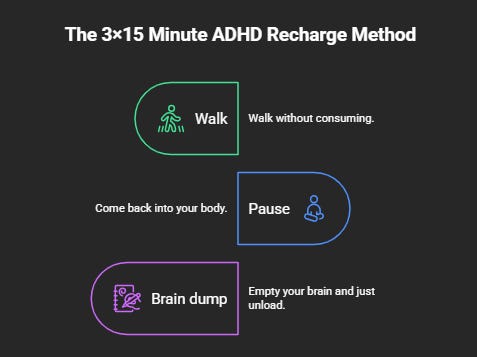
🚶 Reset 1: Walk Without Consuming
Go outside. Walk around your neighborhood. But try something different.
Don’t fill the silence. No podcast. No audiobook. No scrolling.
Just walk.
Your brain spends most of the day receiving information. Messages. Notifications. Conversations. Tasks. A quiet walk gives your mind space to process. Many people notice their best ideas don’t appear when they force themselves to think. They appear when they stop forcing.
Sometimes the solution arrives when you finally give your brain room to breathe.
🧘 Reset 2: Come Back Into Your Body
ADHD can make us live almost entirely in our thoughts.
Planning. Remembering. Analyzing. Trying to stay ahead.
Until suddenly our body sends the signal: “I’m overwhelmed.”
A simple body scan can interrupt that pattern.
Take a few minutes and ask:
Are my shoulders tense?
Is my jaw tight?
Am I breathing deeply?
Where am I holding stress?
You don’t need to fix anything immediately. The first step is simply noticing.
Because awareness creates a pause. And sometimes a pause is exactly what your nervous system needs.
✍️ Reset 3: Empty Your Brain
One of the most exhausting things about ADHD is trying to keep everything in your head. Tasks. Ideas. Reminders. Worries. Things you don’t want to forget. Your brain was designed to create thoughts. Not to store hundreds of unfinished loops.
Do a brain dump. Take a notebook. Write everything down. Don’t organize. Don’t make it pretty. Don’t create the perfect productivity system. Just unload.
Ask yourself:
“What is taking up space in my mind right now?”
“What is draining my energy?”
“What is the smallest next step?”
Sometimes clarity doesn’t come from thinking harder. It comes from carrying less.
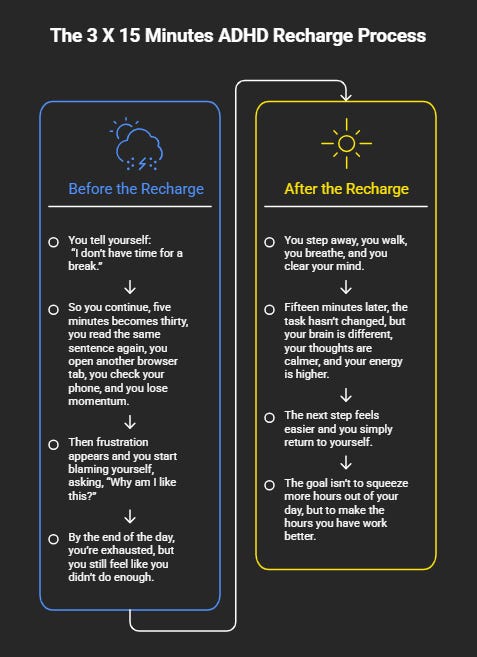
🌧 Before the Recharge
You tell yourself: “I don’t have time for a break.”
So you continue. Five minutes becomes thirty. You read the same sentence again. You open another browser tab. You check your phone. You lose momentum.
Then frustration appears. And the most painful part?
You start blaming yourself. “Why am I like this?”
By the end of the day, you’re exhausted. But you still feel like you didn’t do enough.
☀️ After the Recharge
You step away. You walk. You breathe. You clear your mind. Fifteen minutes later, the task hasn’t changed. The email is still waiting. The problem is still there.
But your brain is different. Your thoughts are calmer.
Your energy is higher. The next step feels easier. You don’t suddenly become a different person. You simply return to yourself.
The goal isn’t to squeeze more hours out of your day.
The goal is to make the hours you have work better.
🧪 Why This Works
This is not about motivation. It’s about how the brain restores itself.
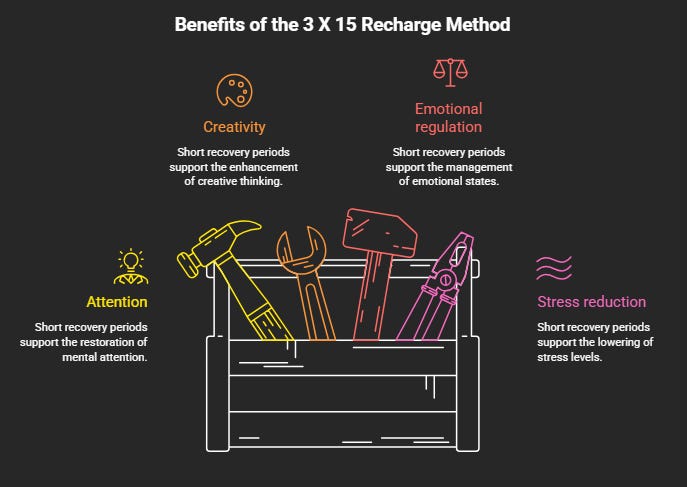
Research shows that short recovery periods can support:
✅ Attention ✅ Creativity ✅ Emotional regulation ✅ Stress reduction
Walking helps restore mental attention. Mindfulness helps calm the nervous system. Writing reduces the load placed on working memory. Your brain isn’t designed for endless output. It is designed for rhythm.
Work. Recover. Work again.
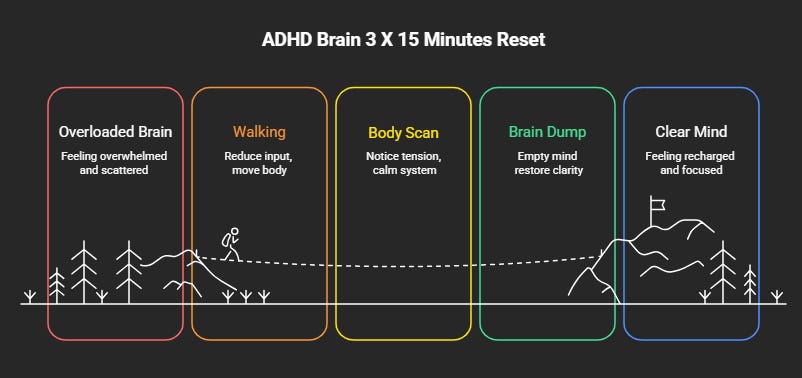
📌 ADHD 3X15 Reset Cheat Sheet
Save this for the next day your brain feels overloaded.
The 3×15 Reset
🚶 15 minutes walking: Move your body. Reduce input.
🧘 15 minutes body scan: Notice tension. Calm your system.
✍️ 15 minutes brain dump: Empty your mind. Restore clarity.
Remember: Recharge before you crash.
❤️ One Last Thought
For years, I believed productive people were the ones who could push through anything. Now I believe something different. The people who create sustainable results are not the ones who ignore their limits.
They understand their energy and resource management.
Because time is not your only resource.
Your attention is a resource.
Your emotional capacity is a resource.
Your mental energy is a resource.
Protecting those resources is not weakness… it is wisdom.
Your ADHD brain doesn’t need more pressure. It needs better support.
And sometimes the most productive thing you can do... is pause.
💬Your Turn
When your ADHD brain feels completely drained, what helps you come back?
🚶 A walk? 🧘 A few minutes of mindfulness? 🎵 Music?
📖 Reading? ☕ Quiet time?
Share your reset ritual in the comments. Your experience might be the exact idea another person needs today.
If this article helped you:
❤️ Like it so more people can discover it.
💬 Comment and share your experience.
🔄 Share it with someone who always feels guilty for resting.0*
📩 Subscribe to ADHD Wisdom Tools for practical, science-backed strategies designed to help you work with your ADHD brain—not against it.
📚 Learn More: The Science Behind This
Want to explore the research?
🧠 Walking and creativity
Stanford University research on walking and creative thinking.
🧘 Mindfulness and stress regulation
American Psychological Association resources on mindfulness.
🌿 Attention restoration and nature exposure
Research on how natural environments help restore attention.
🏃 Physical activity and mental health
Centers for Disease Control and Prevention resources.
The science is becoming clearer: Your brain doesn’t perform better when you ignore its needs. It performs better when you respect them.
Awesome suggestions.
Hope it helps you Brian 🤞