

🔥The Finish Line That Never Comes
Have you ever told yourself:
“Just one more quick check… then I’ll stop.”
Or in spanish “La ultima… y nos vamos…”
Only to realize two hours later that you’re still there, tired, irritated and too wired to rest? That’s not laziness.
That’s ADHD.
Your brain didn’t ignore your intention — it never received a stop signal.
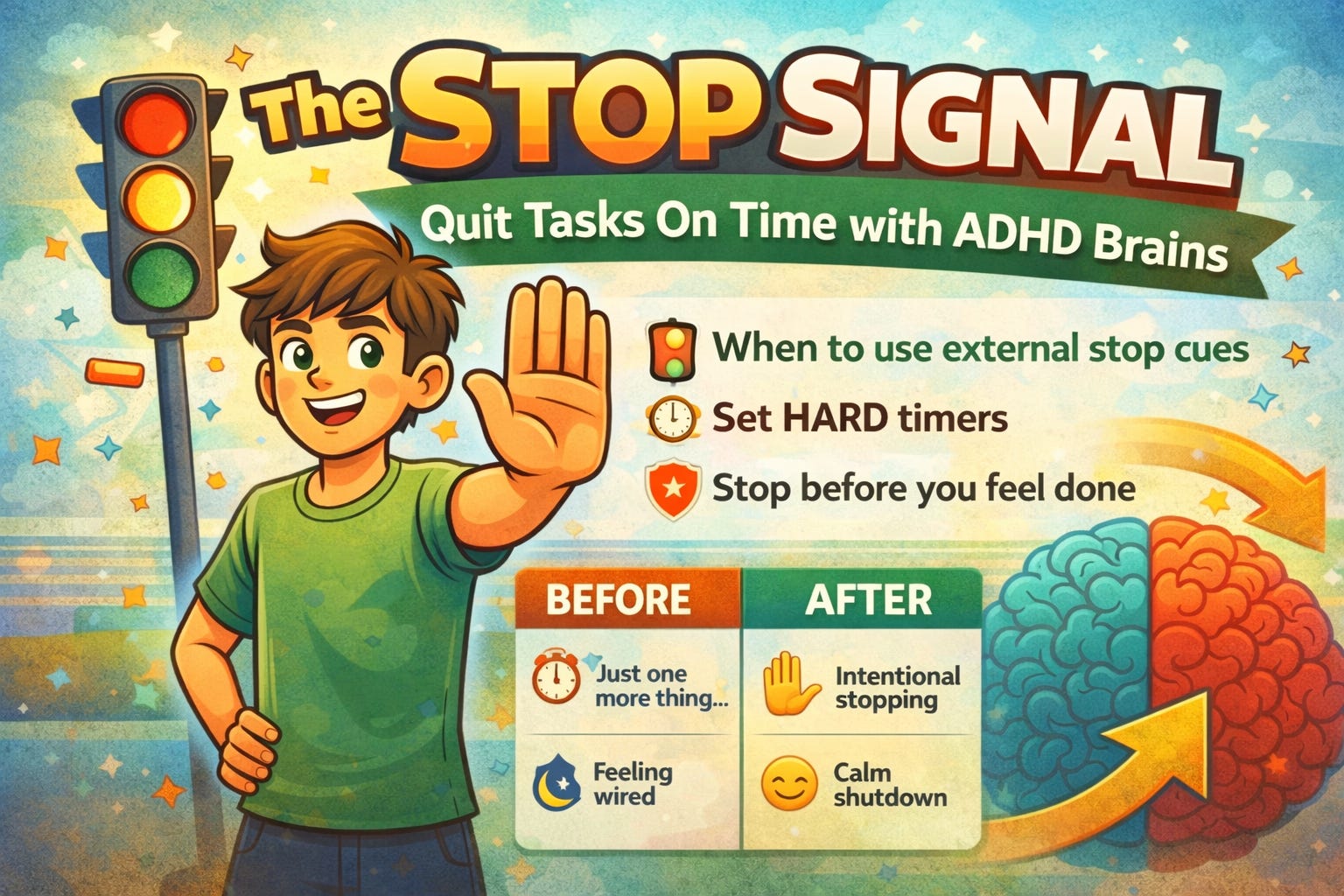
🧠 What’s Really Going On (ADHD + Stopping)
If you have ADHD, the end of a task feels like a suggestion, not a command.
Why?
Because ADHD affects executive functions, especially:
Inhibitory control (stopping an action)
Task switching
Time perception
Closure recognition
In simple terms:
👉 Your brain struggles to say “enough.”
So instead of stopping, you chase completion.
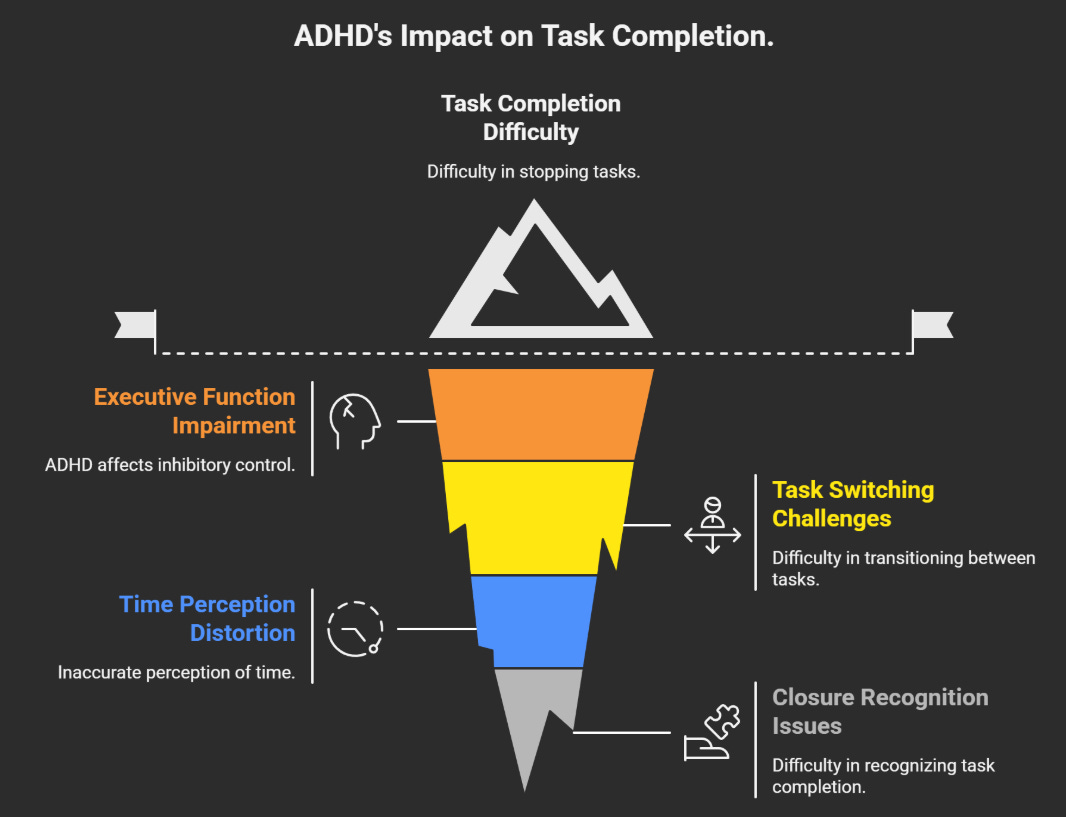
📌 This Is NOT Just Procrastination
Most ADHD advice focuses on starting. But there’s a quieter problem:
ADHD brains struggle to stop once engaged.
This shows up as:
“I’m almost done…” → hours later
Difficulty stopping mid-task
Work bleeding into rest time
Feeling mentally “stuck on”
This isn’t a character flaw, it’s executive function dysregulation.
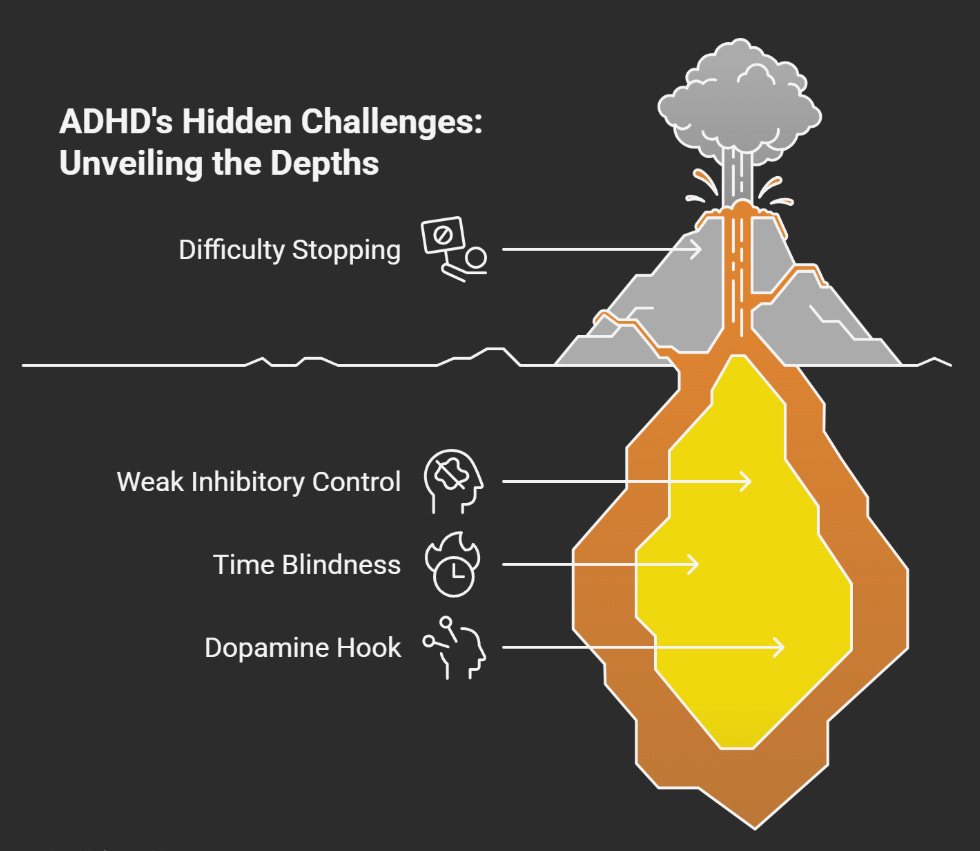
🧠 The Science (Simple Version)
🔬 1) Weak Inhibitory Control
ADHD brains have difficulty interrupting an ongoing action, even when the intention to stop is clear.
👉 Your brain keeps the motor running.
⏳ 2) Time Blindness
You don’t feel time passing accurately, so stopping feels arbitrary — or wrong.
👉 “Just 5 more minutes” has no meaning.
⚡ 3) Dopamine Keeps You Hooked
Once engaged, your brain wants to squeeze every drop of stimulation — even when you’re exhausted.
👉 Stopping feels like loss.
🚦 Introducing: The Stop Signal
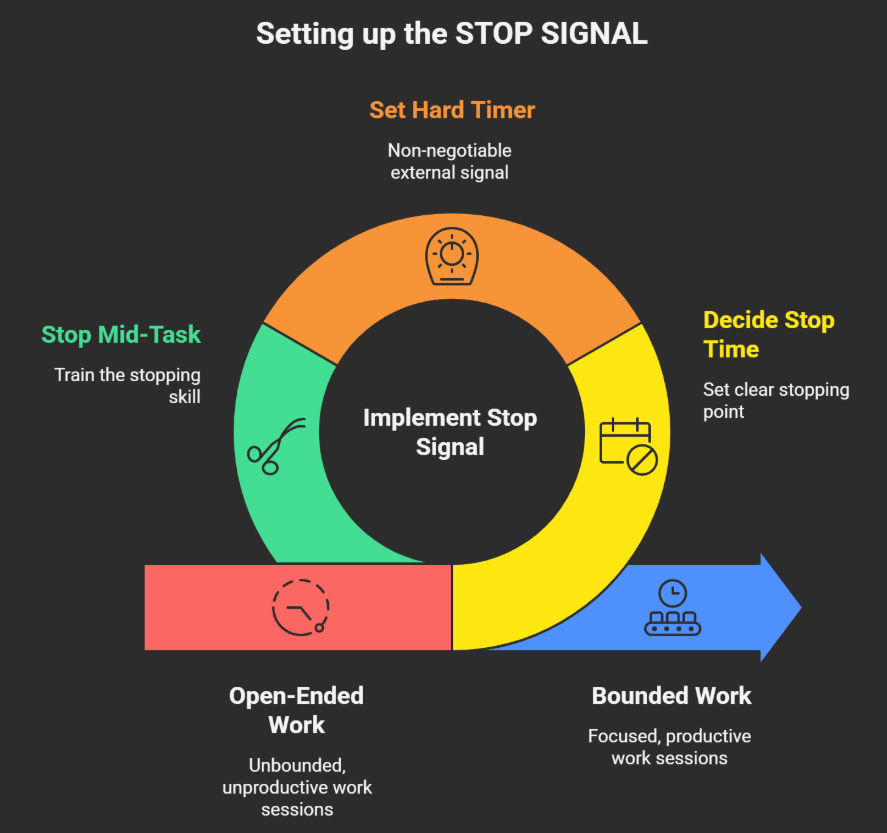
Stopping isn’t about discipline. It’s about externalizing control.
Think of it as installing a stoplight 🚦 outside your brain.
🛠️ The Stop Signal System
1️⃣ ✍️ Decide the Stop Time Before You Start
Say it clearly:
“I will stop at 18:30, no matter what.”
This moves you from open-ended work to bounded work.
2️⃣ ⏱️ Set a HARD Timer
Not a reminder. A non-negotiable signal.
Your ADHD brain listens better to external cues than internal promises.
3️⃣ 🎯 Stop Mid-Task on Purpose
This is the uncomfortable part and the most powerful.
👉 Stop before you feel done.
Why? Because stopping itself is the skill you’re training.
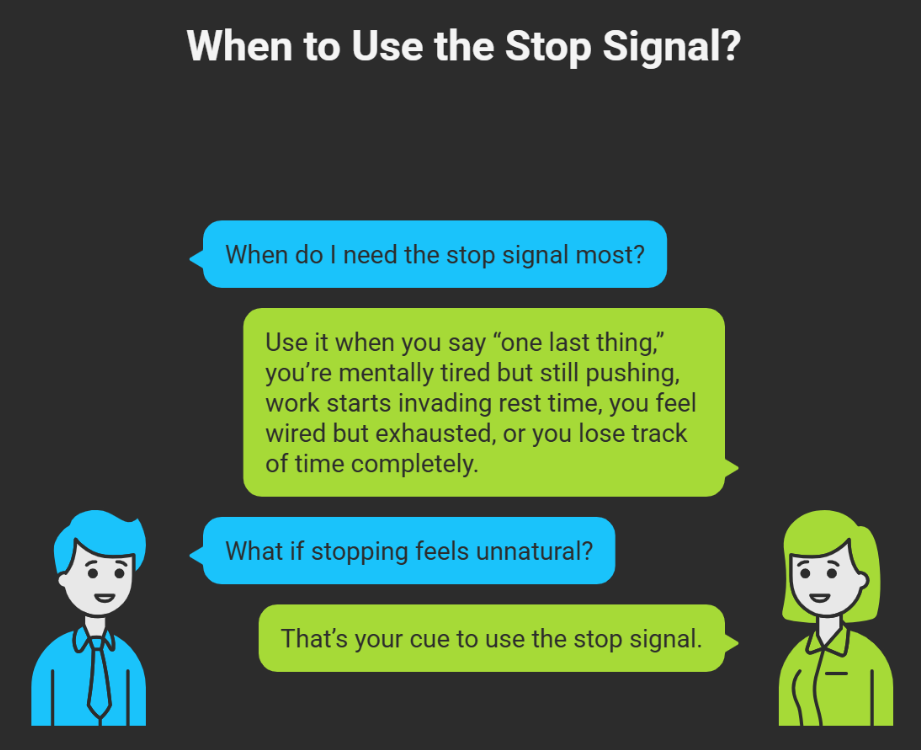
⏱️ When You Need the Stop Signal Most
Use it when:
You say “one last thing”
You’re mentally tired but still pushing
Work starts invading rest time
You feel wired but exhausted
You lose track of time completely
If stopping feels unnatural 👉 that’s your cue.
💥 Impact — What Changes Over Time
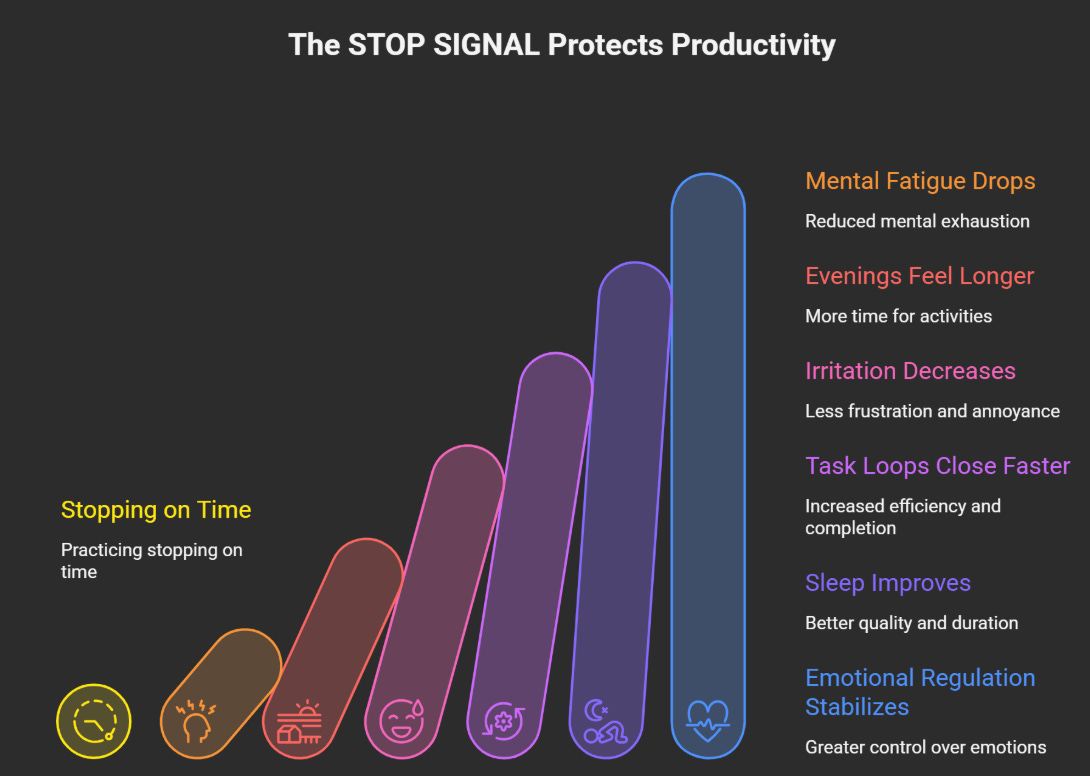
When you practice stopping:
🧠 Mental fatigue drops
⏳ Evenings feel longer
😤 Irritation decreases
🔁 Task loops close faster
🌙 Sleep improves
🧘 Emotional regulation stabilizes
Stopping on time doesn’t reduce productivity —
it protects it.
🧠 Before vs After — The Stop Signal Effect
🚨 Before:
⏰ “Just one more thing…”
🌙 Wired at night
💻 Work bleeds into life
⚡ Constant mental friction
✅ After:
✋ Intentional stopping
😌 Calm shutdown
🛑 Clear boundaries
🌿 Cognitive relief
🎯 Final Thought
Stopping is not a weakness.
It’s an executive skill.
ADHD brains don’t stop naturally, they need structure, signals and permission.
And once you train stopping, everything else gets easier.
You’re not broken. You’re just missing a stop signal 💙
🐱 Your brain is like a cat: It won’t stop unless something external tells it to.
💬 Do you struggle more with starting or stopping?
🔁 Share this with someone stuck in “almost done” mode
📩 Subscribe to ADHD Wisdom Tools for science-backed, real-life ADHD strategies
🔗 Some More Adhd Wisdom tools from the toolkit
📌 ADHD Hyperfocus Overload: When Deep Focus Derails … — Understand hyperfocus and how to regain control, with a visual stop cue strategy.
⏱️ Pomodoro Power: How 25 Minutes Can Unlock ADHD Focus — Use Pomodoro as a built‑in stop signal to manage time and focus.
🧠 How to Stop Losing Everything? ADHD‑Friendly Systems That Work — Practical systems for organization and reducing overwhelm.
⚡ ADHD Rage: Why You Go from 0 to 100 (And What to Do Before You Snap) — Tools to regulate intense emotions and stress responses.
🌪️ ADHD Avalanche: How to Stop Emotional Overload & Stay Calm — Strategies to manage emotional chaos and interruptions.
🔄 Unlock Your ADHD Focus with the Zeigarnik Effect — Turn open loops into productivity fuel and reduce cognitive load.
That’s honestly something I have found challenging my whole life. I tell myself I’ll stop doing this in a second, then four hours go by, and I am still still doing the thing
This is really good, practical advice. The "bounded work" frame is particularly useful — I use similar language with patients who describe feeling "trapped" in tasks.
One clinical distinction worth adding: what you're describing here is primarily an inhibitory control deficit (the brake pedal), but it often gets confused with hyperfocus, which is different. Hyperfocus involves reduced awareness of external cues AND time distortion. What you're targeting with the stop signal is earlier in the chain — the ability to disengage from a rewarding stimulus even when you're aware you should stop. That's frontostriatal circuit stuff, and external timers work precisely because they bypass the faulty internal signal. The reason "stopping mid-task on purpose" feels so uncomfortable is that you're essentially doing reps against your brain's dopamine-seeking default. It's exposure therapy for task closure. The discomfort is the point — you're building the neural pathway that ADHD didn't give you for free.