

Multitasking is productivity gold according to the experts.
Everywhere you look, it’s the same message: do more, faster, in parallel.
Keep multiple tabs open. Answer messages while working.
Plan, execute, optimize — all at once.
In all for your ADHD brains it’s… OVERWHELM!
On paper, it sounds efficient. And apparently it works beautifully… for neurotypical brains. If you’re neurotypical, you can jump between tasks and your brain more or less keeps up.
For my ADHD brain? Multitasking is where good intentions go to die.
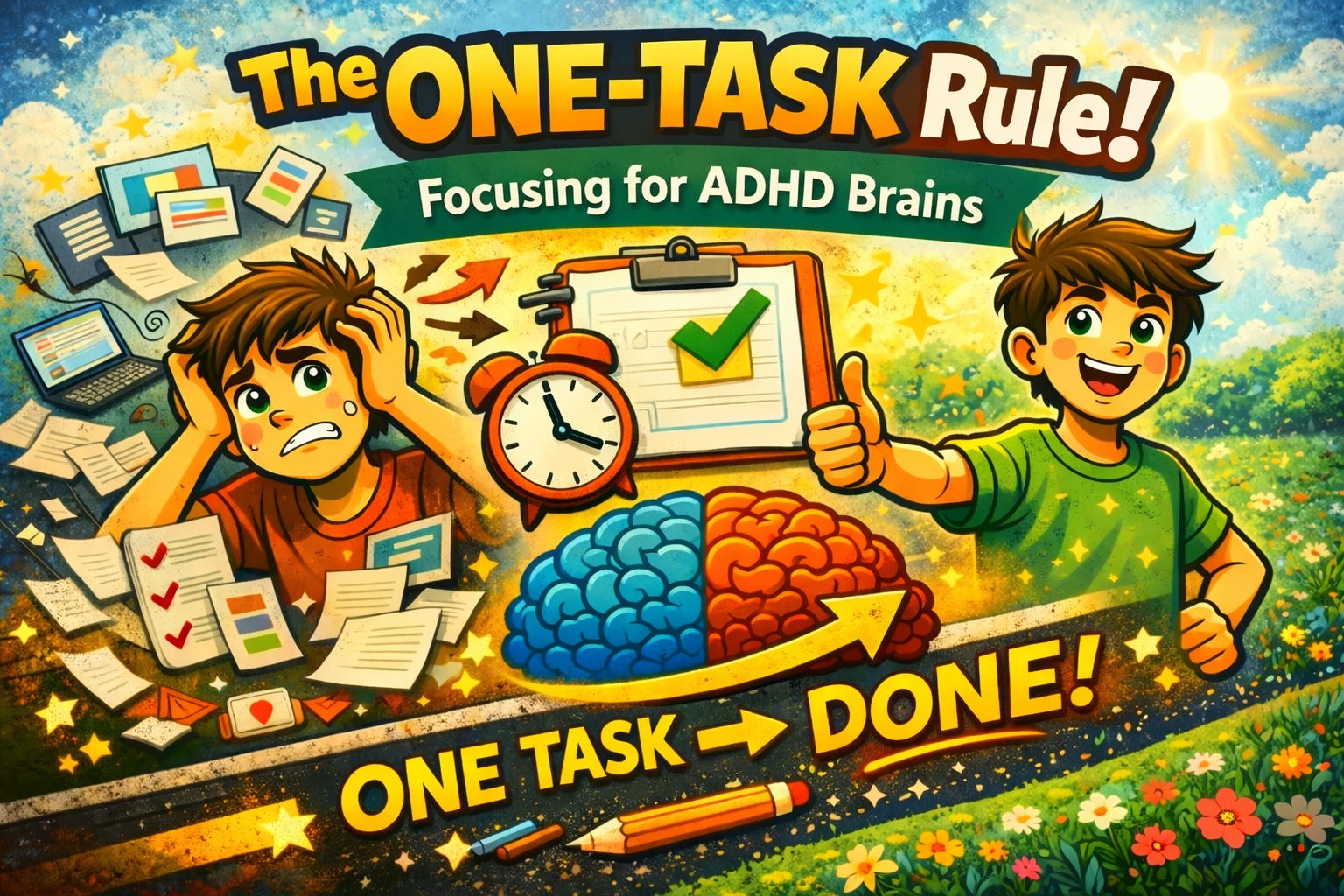
🎯 What You’ll Learn
By the end of this article, you’ll understand:
🧠 Why multitasking feels productive but isn’t
⚡ Why ADHD brains suffer more from task switching
🔁 What actually changed when I switched to one task
🛠 How to apply the One-Task Rule in real life
📉 The daily impact on focus, energy, and clarity
😵 Multitasking doesn’t work for me
I really tried. I tried being the person with:
📝 a clean to-do list
📅 a packed schedule
🔄 and 10 things “in progress”
It looked productive from the outside.
But in reality? Nothing was ever finished.
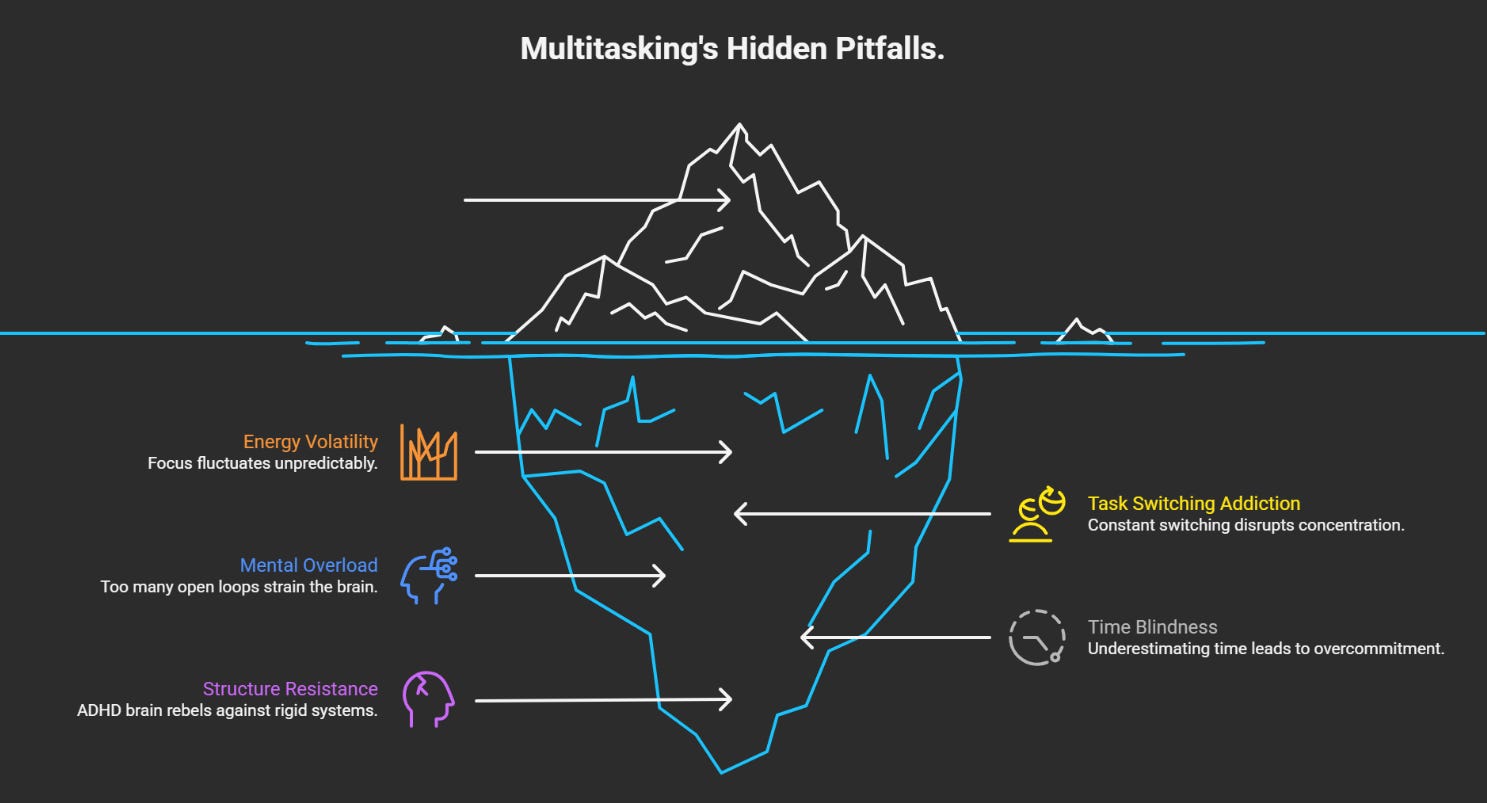
⚡ Energy and focus volatility
Some days I could write for hours. Other days I couldn’t even open the document.
🔁 Task switching addiction
Every time something felt slightly boring, I’d switch. Email. Slack. Research. Notes. Back again.
🧠 Mental overload
Too many open loops meant my brain was constantly negotiating with itself.
So try closing the loops.
⏳ Time blindness
I always thought I could handle “just one more thing”. I never could.
🚧 Structure resistance
The more I tried to force myself to juggle everything, the more my brain quietly rebelled. I wasn’t lazy. I wasn’t unmotivated. I was just trying to run an ADHD brain on a system built for a different operating system.
💡 The moment it clicked
The shift happened on a very ordinary day.
I sat down to work. Opened my laptop. And instantly froze.
Not because the task was hard. But because there were too many choices.
So I said it out loud: 👉 “I only have one job right now.”
Not for the day. Not for the hour.
Just for this moment. And something strange happened.
My brain… calmed down.
🧠 What’s actually going on in the brain
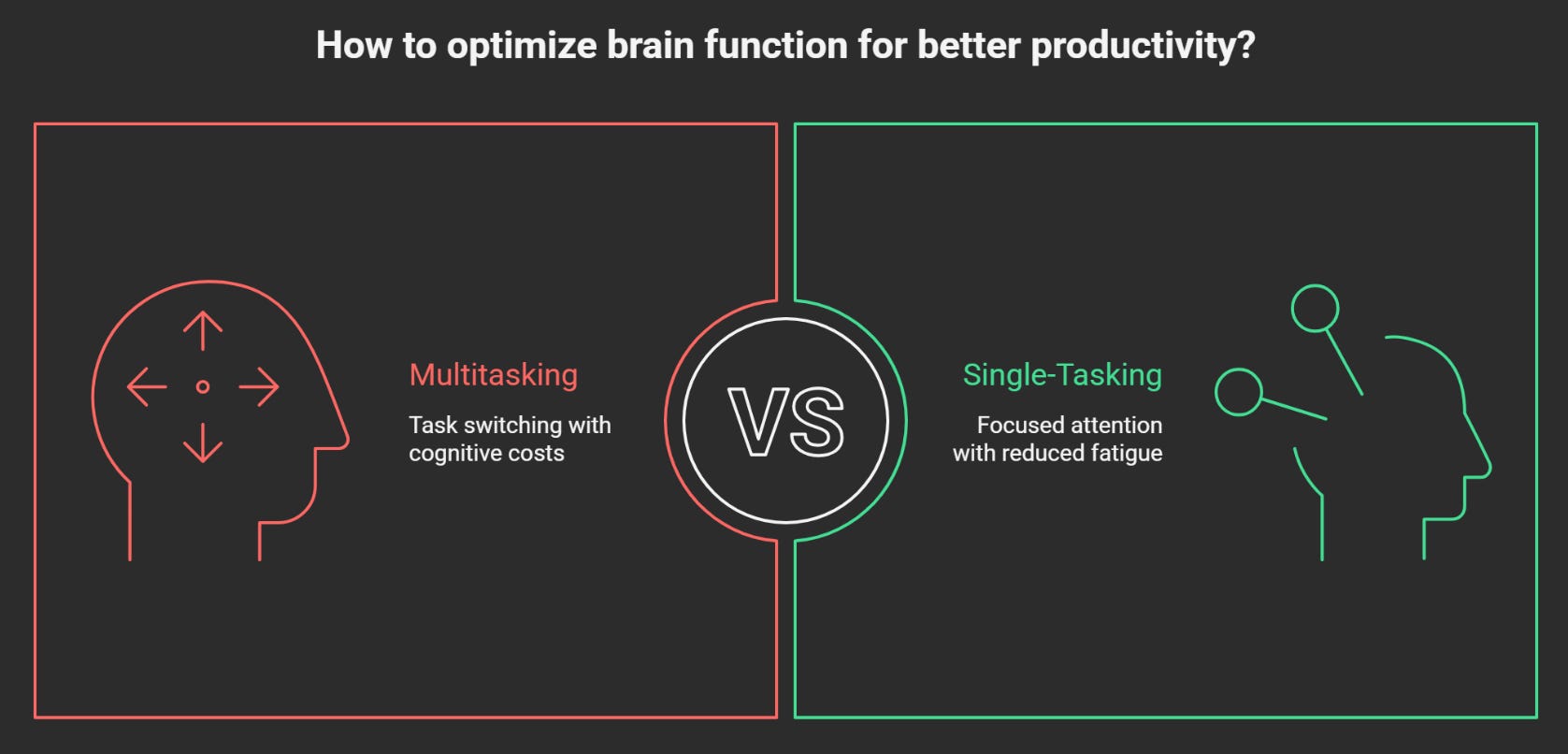
What we call “multitasking” is actually task switching.
The brain can’t truly focus on two things at once. It just keeps jumping.
And every jump has a cost:
🧩 more cognitive load
🔋 more decision fatigue
📉 less working memory
😵 more mental exhaustion
ADHD brains feel this even more because:
🎯 attention is interest-based
🎢 dopamine is inconsistent
🧠 working memory is fragile
So the more tasks are open, the more the brain burns energy deciding instead of doing.
It feels busy.
But it’s mostly noise.
🔬 Scientific Backing (Real & Short)
Research confirms this:
📉 The American Psychological Association shows that task switching can reduce productivity by up to 40% research
🧠 Stanford researchers found heavy multitaskers are worse at filtering information
⚠️ MIT neuroscientists show switching activates conflict-processing areas of the brain
So no — it’s not a “you problem”. It’s a brain mechanics problem.
🚨 The Alternative: The One-Task Rule
Instead of trying to manage everything, I switched to one simple rule:
👉 One task at a time
That’s it.Not one project. Not one goal. Just one current action.
My system now looks like this:
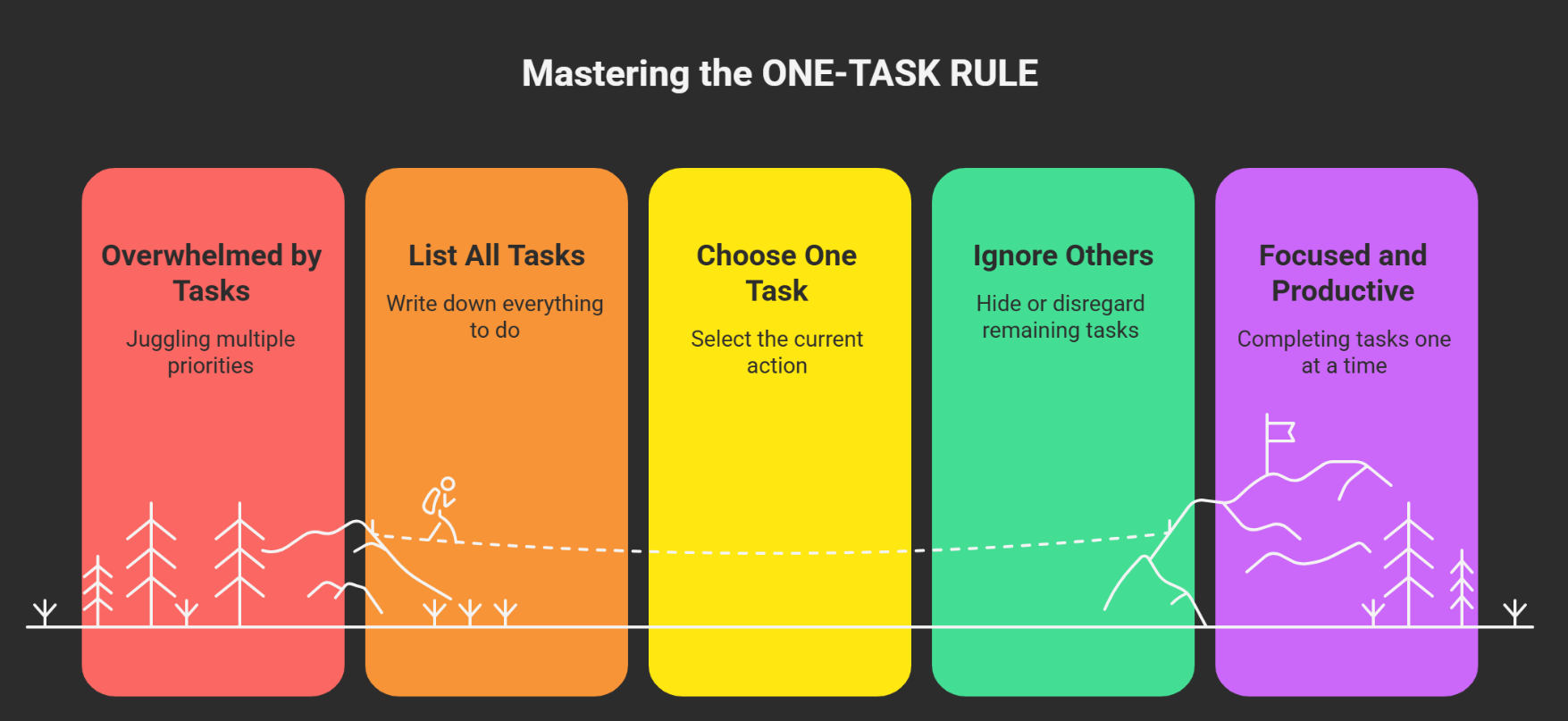
📝 I write down everything I need to do
🎯 I choose one task
🙈 I hide or ignore the rest
⏱ I work until a natural stop
➡️ Then — and only then — I choose the next one
No parallel tracks. No background tasks. No “just quickly”.
Just one.
🔁 Before vs After
❌ Before (Multitasking Mode)
🌐 Too many tabs
🔄 Constant switching
📱 Notifications everywhere
😵 Mental fatigue
❓ Busy but stuck
✅ After (One-Task Mode)
🎯 One clear target = Clarity
🔇 Less noise
✔️ Real progress
😌 Calm focus
✨ Momentum
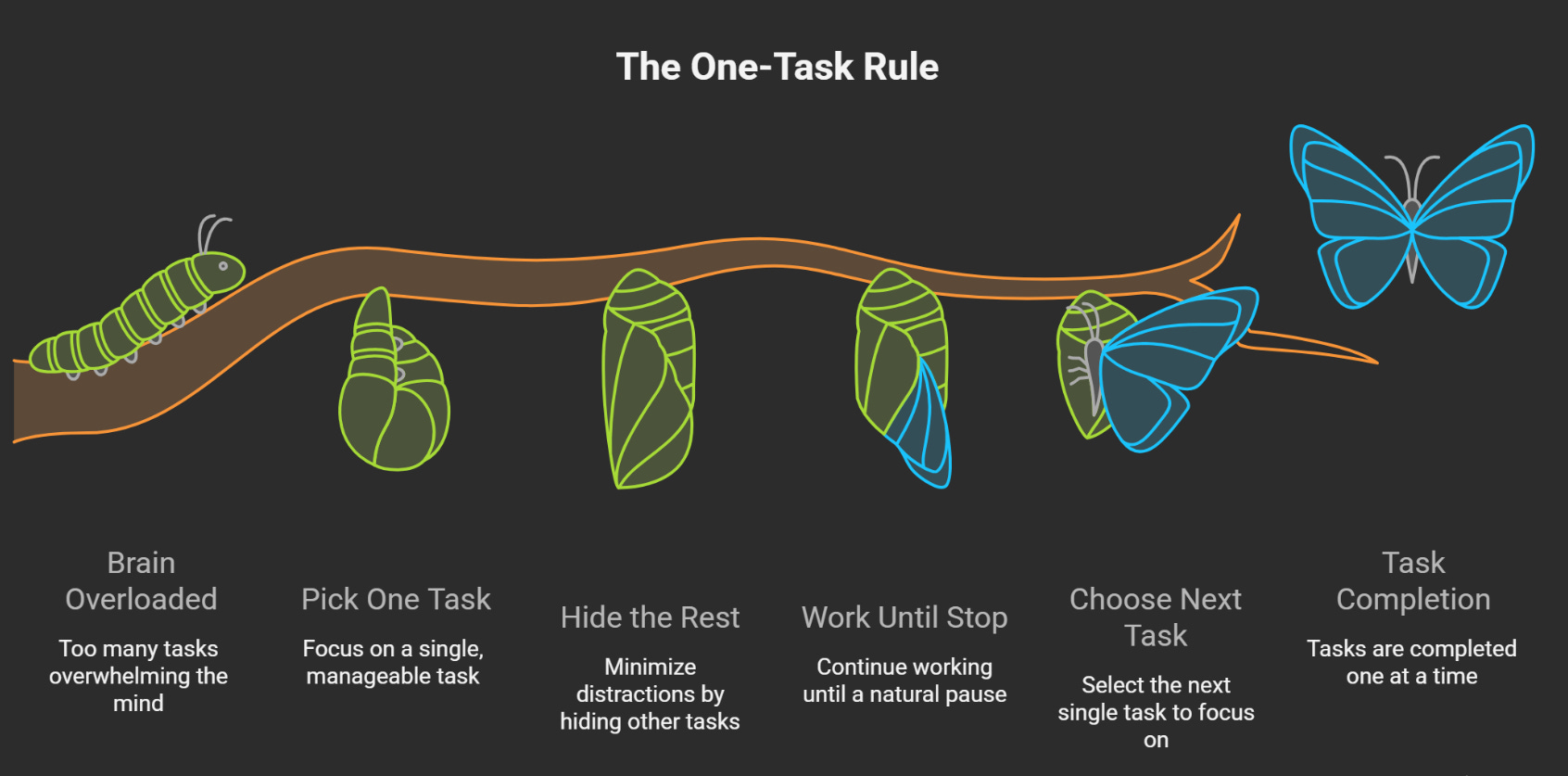
📌 Cheat Sheet — The One-Task Rule
Think of it like a loop:
🧠 Brain overloaded
🎯 Pick one task
🙈 Hide the rest
⏱ Work until natural stop
➡️ Choose next one
Repeat:
✔️ Done → 🎯 One → ✔️ Done → 🎯 One → …
⚡ When to Use It
The One-Task Rule is perfect when:
📋 Your to-do list feels too big
🔄 You keep task switching every 2 minutes
😴 You’re tired but nothing is finished
📱 You feel the urge to “just check one thing”
🧠 You’re overthinking instead of doing
That’s your signal: 👉 Time for one task.
🌱 Daily Impact (What Changed for Me)
Since using this daily:
✨ I start faster
✨ I finish more
✨ I feel less guilty
✨ I’m less exhausted
✨ My brain feels quieter
Not because I became disciplined. But because I finally reduced friction.
🐱 CAT Comment
Even cats don’t multitask.
They stare. They wait. Then they pounce.
No juggling. No context switching. Just one target. Honestly… cats get it.
🌈 Final Thought
For years I thought I needed:
more discipline
better systems
stronger willpower
What I actually needed was:
👉 less noise and one clear direction.
The goal isn’t perfect productivity.
The goal is getting things done without burning out.
And for my ADHD brain…
One task at a time is the closest thing I’ve found to peace.
❤️ Takeaway
👉 One thing done beats ten things started.
Not because you worked harder.
But because you finally worked with your brain instead of against it.
If this resonated:
💌 Share it with someone who feels busy but stuck
⭐ Subscribe to ADHD Wisdom Tools for practical systems that respect how ADHD brains actually work
And right now, gently ask yourself:
What’s my one task?
🔗 Related Articles from ADHD Wisdom Tools
If this article resonated, you’ll probably love these too:
🧠How to Make Choices with ADHD: Simple Strategies for Stress-Free Decisions
🚦 The Stop Signal : Why ADHD Brains Can’t Quit Tasks — And How to Train Yourself to Stop
🧠 The Next Effect: Why Momentum Matters More Than Motivation
How to keep going once you’ve finally started — and why “next” is the real secret.
⚡ The Done Effect: Why Finishing One Small Thing Changes Everything
The psychology of completion and how tiny wins rewire your brain.
🚀 Why Starting Feels Impossible with ADHD (And How to Make It Easier)
A deep dive into task initiation paralysis — and practical ways around it.
⏱ How to Clear Your To-Do List with the 30-Seconds Rule
For when everything feels heavy and you need an ultra-low friction entry point.
🧩 The 5-1 Rule: How to Beat ADHD Procrastination with Small Wins
A simple system: 5 tiny tasks → 1 important task → real momentum.