


🔁😬 Oops Loops: Why ADHD Brains Make "Careless" Mistakes (and What Actually Helps)
🚨 Stop beating yourself up - understand the science behind your careless mistakes and learn ADHD-friendly strategies to catch them before they happen

👀 It Started with one tiny mistake…
A while back, I poured hours into a presentation. Made the slides, wrote the notes, rehearsed like crazy.
Then the big day came... and I sent the deck with the wrong client’s name on the first slide. 😬
Cue the flush of heat on my face.
That spiraling voice:
“Why do I always mess up the easy stuff?”
That moment? It wasn’t laziness.
Sound familiar?
It was The Oops Loop 🔁😬, a pattern specific to ADHD brains.
Here’s what it is, why it happens and how to break the loop for good.
Let’s dive in!

❓ What Is the Oops Loop™? 🔁😬
The Oops Loop™ is the ADHD-specific cycle of seemingly “careless” mistakes — forgetting steps, skipping checks, or hitting send too fast.
It’s not because you’re careless.
🧠It’s because your brain handles attention, time and self-monitoring differently.
🔄 The Oops Loop Cycle
1️⃣ Start task (usually fast or with pressure)
2️⃣ Brain skips a step (due to attention blink, memory drop, or impulsive click)
3️⃣ Mistake happens (and you don’t notice until later)
4️⃣ You catch it — too late
5️⃣ Shame + hypervigilance or burnout → Repeat next time

⏰ When Does the Oops Loop Strike? 🔁😬
🌀 During boring or repetitive tasks
💥 When you're hyperfocused - but only on the wrong thing
⏳ In a rush
📱 After an interruption
😅 When you're feeling really confident or energetic
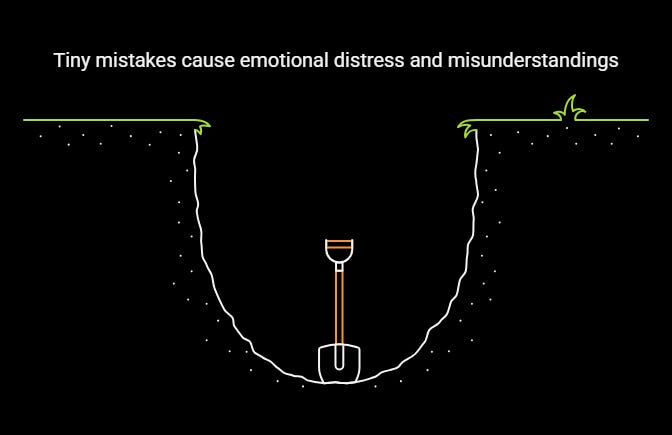
💣 The Impact of Tiny Mistakes
😞 Embarrassment & self-blame
🔁 Procrastination (to avoid shame)
📉 Damaged confidence
💔 Misunderstandings with people
🤯 Emotional burnout from “fixing” mistakes you didn’t realize you made

🧠 Why It Happens (Backed by Science)
✅ 🧩 Working memory overload
ADHD brains have limited capacity to hold and manipulate info at once. That means steps drop out mid-task — even if you knew them 2 seconds ago.
🔗 Martinussen et al., 2005 – Meta-analysis on working memory & ADHD
✅ 📉 Low dopamine levels
Dopamine fuels motivation and sustained attention. ADHD brains are under-stimulated by default, especially during boring or repetitive tasks — making focus flicker.
🔗 Arnsten, A.F.T., 2009 – Dopamine & Prefrontal Cortex in ADHD
✅ 🚫 Impaired self-monitoring
The part of the brain that checks for errors and says “Wait, did I just mess up?”
often isn’t activated in time, so you catch mistakes after they happen, not during.
🔗 Barkley, R.A., 2011 – Executive Function Theory
✅ ⏳ Time blindness
ADHD warps time perception, you underestimate how long things take, overcommit or rush and skip key steps.
🔗 Barkley et al., 2001 – Time Perception and ADHD
✅ 😅 Emotional regulation & “toxic positivity”
Feeling too good (excited, confident, energized) can actually suppress caution and critical thinking - especially when dopamine is surging.
🔗 Fredrickson & Joiner, 2002 – Positive Emotion and Critical Thinking
✅ 🤯 Overconfidence and impulsivity
ADHD increases impulsivity — which, mixed with moments of confidence, can lead to pressing “send” or making decisions without that final gut-check.
🔗 Seli et al., 2016 – Mind-Wandering With and Without Intention
🔁😬 Break the Cycle: Oops Loop Exit Plans
Here are strategies, grouped by how they support your brain.
🧱 STRUCTURE |
External Systems That Catch What You Miss
🧩 Break tasks into micro-steps
🧠 Your brain skips steps unless they’re visible.
⏲️ Time-block buffers
Add 15 minutes to review before deadlines.
📋 Use checklist rituals
Always follow the same order before pressing “send” or uploading anything.
🎯 FOCUS | Get In, Stay In, Shut Distractions Out
🧘 Begin with 60 seconds of stillness
Resets your nervous system & calms urgency mode.
🔕 Silence is a tool
Use Do Not Disturb + noise-blocking to stay locked in.
💻 Close everything else
Use “One Tab Rule” for critical tasks.
🔔 MEMORY | Support the Stuff That Slips
📳 Triple-layer reminders
Use alarms + sticky notes + a digital pop-up.
🎨 Use color, shape or icons
Visual memory is stronger than verbal for ADHD brains.
🔁 Automate what you can
Set up email rules, recurring task templates, and auto-checklists.
🧠 SELF-AWARENESS | Review Before You Regret
🧠 End every task with an “Oops Check”
Ask: What would I forget right now?
👯 Use body doubling or accountability apps
Apps like Caveday to give your brain the presence of a second mind.
🎤 Say your steps out loud
Engaging multiple senses reinforces awareness.
🌡️ EMOTIONAL SAFETY | Regulate the Confidence Spike
😎 Slow the hype train
Feeling too good? Pause before you hit send or say yes.
💬 Ask: “What could go wrong?” (gently)
Not catastrophizing - just giving the brain contrast so it thinks deeper.
🪞 Check your vibe before the task
Happy-go-lucky + hyper = prime time for forgetting the basics.
💫 Before & After: Real ADHD Upgrade
BEFORE 😵💫
📎 Forgot the attachment
📛 Misspelled the client’s name
🗓️ Missed the due date
🫠 Felt like a failure
AFTER 😎
✅ Checklist loaded
✅ One-tab focus
✅ 15-minute buffer
✅ Pressed send with peace of mind
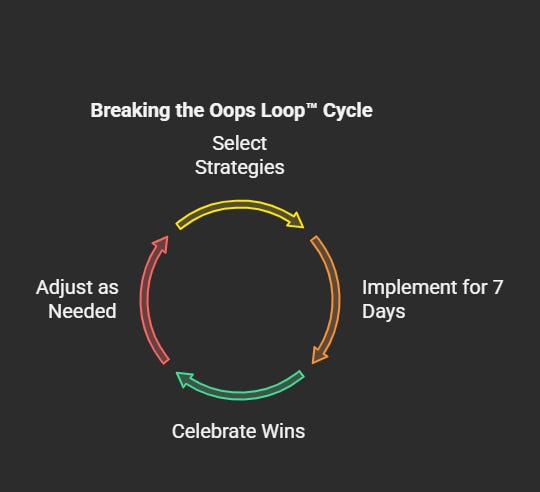
✅ Action Plan: Break The Oops Loop™ 🔁😬
🟠 Pick 1 strategy from each cluster
🟠 Try it for 7 days on repeat tasks
🟠 Celebrate the tiniest wins
🟠 Adjust as needed — your brain is unique
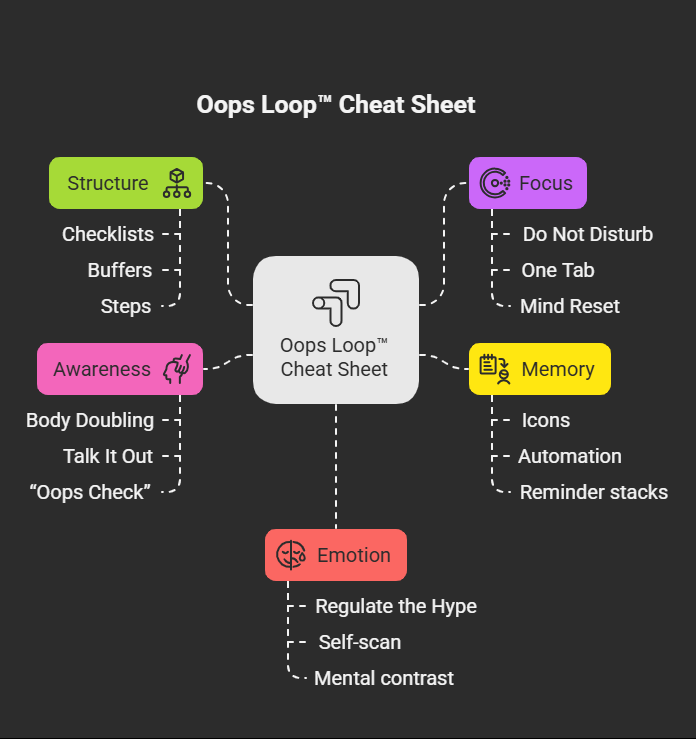
🧾 Oops Loop™ Cheat Sheet 🔁😬
🧱 Structure: ✅ Checklists | ⏲️ Buffers | 📋 Steps
🎯 Focus: 🔕 Do Not Disturb | 💻 One Tab | 🧘 Mind Reset
🔔 Memory: 🧷 Icons | 🔁 Automation | 📳 Reminder stacks
🧠 Awareness: 👯 Body Doubling | 🗣️ Talk It Out | 🤔 “Oops Check”
🌡️ Emotion: 😅 Regulate the Hype | 🪞 Self-scan | 💬 Mental contrast
🔧 Favorite Tools (That Actually Work for ADHD)
🧠 Notion — fully customizable brain dump
📱 Todoist — task tracker w/ subtask trees
🎧Caveday — cowork with strangers for structure
📆 Sunsama — time block & reflect
⏲️ Time Timer — visual countdown
🧼 Grammarly — writing safety net
🧠 Final Thought
You’re not “careless.” You’re not broken.
You’re managing an Olympic-level brain with a to-do list that wasn’t designed for it.
⚡ Tiny systems.
⚡ Big relief.
⚡ Progress over perfection - always!!!
💬 Your Turn
💬 Comment your favorite ADHD “Oops Loop” moment 🔁😬
🔁 Share with someone who needs this
❤️ Follow for more brain-friendly strategy drops
📩 Subscribe for weekly ADHD hacks that actually help
Excellent, as always. I make my partner's breakfast in the morning (sometimes it's the 1950s in my brain lol). I texted him an hour later and said, "did I put 0,1 or 2 spoons in your bag?" He said 1, is there a spoon emergency? Nope - it's the fact that I have a 2nd interview today for a job I really, really want and need - and my brain was thinking 34768 other thoughts during that boring routine! This post helps me understand how to prevent Bigger Missing Spoons (aka actual mistakes)! Thank you!