
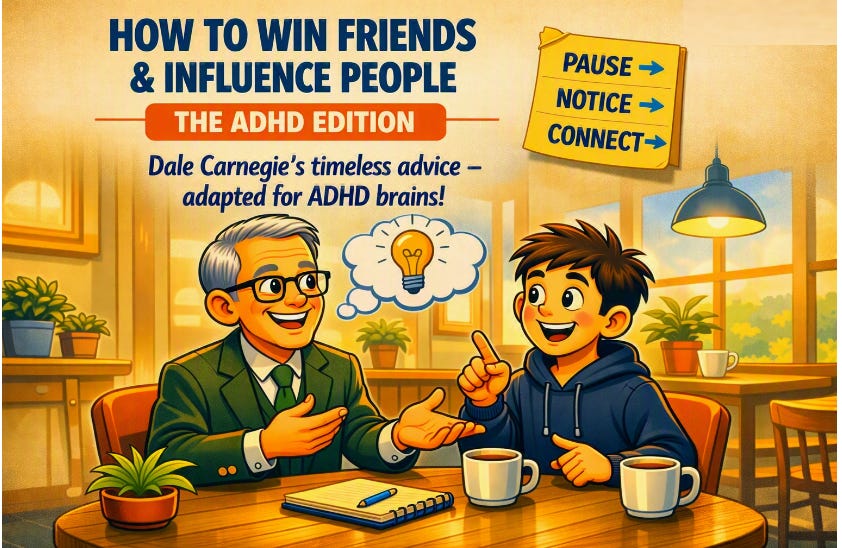
🧠 How to Win Friends & Influence People — The ADHD Edition
Rereading Dale Carnegie through an ADHD brain

I’m currently rereading How to Win Friends and Influence People by Dale Carnegie, and this time I keep asking myself:
“Okay… but how do I actually apply this with ADHD?”
Because the advice sounds simple:
Don’t criticize. Show appreciation. Listen, don’t interrupt. Remember names. Smile. Don’t argue. Show interest and ask questions. Make the other feel seen and important.
Easy, right? Except someone is talking, I’m genuinely listening and suddenly my brain goes: “WAIT. I HAVE A THOUGHT.”
Now I’m trying to remember the thought before it disappears, keep listening and not interrupt. Yep. Me too.
So instead of treating Carnegie’s advice as another list of things we should be better at, let’s turn it into a few ADHD-friendly tools.
🧠 Don’t criticize, condemn or complain
Carnegie’s point is that attacking people usually makes them defensive rather than receptive. ADHD can make this tricky because we often spot problems quickly. You see the inefficient process, the contradiction, the thing that doesn’t make sense — and sometimes you say it before your filter catches up.
Instead of “Why are we doing it like this?”,
try: “Can you help me understand why we chose this approach?”
Don’t suppress the thought. Change the first sentence.
👂 Listen, even when your brain jumps
ADHD listening isn’t always perfectly linear. Your brain wanders. A thought appears. Suddenly you’re trying to hold onto it because you’re afraid it will disappear.
Don’t aim for perfect listening. Aim for coming back.
Write down one word if you need to. Ask someone to repeat themselves if you lost the thread. Returning to the conversation is the skill.
💬 Say the good stuff
You might notice something good about someone and never actually say it.
“That was a great idea.”
“They handled that really well.”
And then your brain moves on, but people can’t hear what you’re thinking. So when you genuinely appreciate something, say it while it’s still there. It doesn’t need to be a big compliment. Just make the thought visible.
🧐 Stay curious
When someone disagrees with you, your brain might already be building the counterargument before they’ve finished speaking.
Try replacing: “How do I prove I’m right?” with “What am I missing here?”
You don’t have to agree. You’re just creating a little space before reacting and sometimes that space changes everything.
🏷️ Remember names — outsource your memory
Carnegie says remembering people’s names matters. Great.
Now let’s ask an ADHD working memory to do that. 😂
Instead of relying on memory, create a hook:
Sarah → Sarah from Finance.
Marc → Marc who cycles.
Give the name somewhere to stick. The bigger ADHD lesson?
When memory is unreliable, build a system instead of blaming yourself.
🗣️ Ask one more question
Someone mentions something you’re interested in and suddenly you’re giving them the extended director’s cut of your entire story. Yep. We’ve all been there.
Try one tiny rule:
Before telling your story, ask one more question. Not ten. Just one. It gives the other person space without asking you to become a completely different person.
🤝 Don’t turn every disagreement into a competition
Carnegie says the best way to win an argument is to avoid it. Hard when your brain is screaming: “But I’m RIGHT.”
Maybe you are … but ask: “Does this actually need to be won?”
Some things matter. Some don’t. Being right and being effective aren’t always the same thing.
❤️ Make people feel seen
A lot of Carnegie’s advice comes back to one simple idea: People want to feel noticed, heard and feeling important. Remember something they told you. Ask how something went. Notice their effort. Listen when they’re excited.
You don’t need a big gesture.
Sometimes: “How did that presentation go?” is enough.
Think it less. Say it more.
⚠️ Don’t turn Carnegie into another ADHD checklist
This is important. You don’t need to remember 30 principles while simultaneously trying to listen, control interruptions, remember names and say the right thing.
That’s just exhausting and Carnegie shouldn’t become another manual for masking. You can still be enthusiastic and smile. You can still lose your train of thought. You can still interrupt sometimes.
The goal isn’t perfection. It’s a little more choice.
🧩 The ADHD version
If I had to reduce the whole book to three things I’d actually remember, I’d keep these:
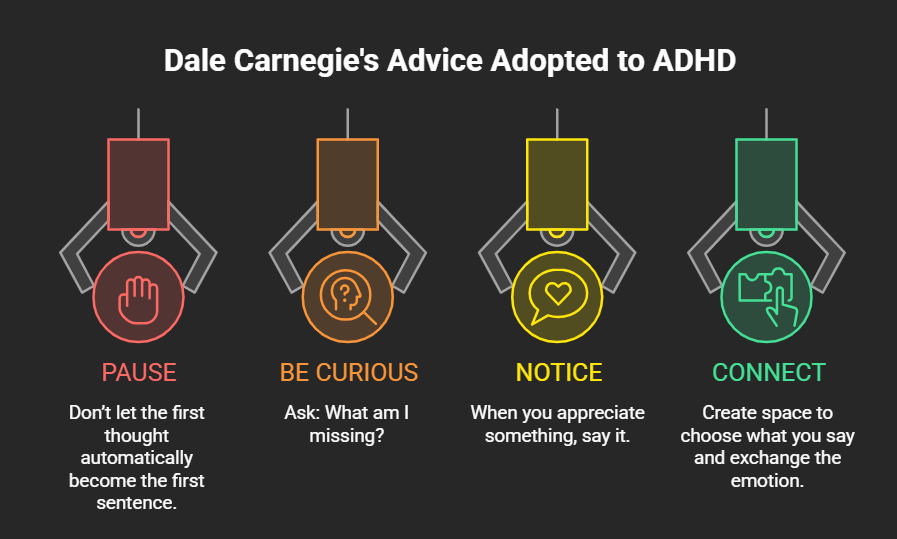
PAUSE — Don’t let the first thought automatically become the first sentence.
CURIOUS — Ask: “What am I missing?”
NOTICE — When you appreciate something, say it.
That’s enough. You can build from there.
✨ Final thought
Rereading Carnegie has reminded me that communication isn’t necessarily about knowing the perfect thing to say. Sometimes it’s about creating just enough space to choose what you say, exchange the emotion and make that connection. And maybe that’s especially useful with ADHD.
Two seconds between the impulse and the response.
Two seconds between “I need to correct this” and “Let me understand first.”
Two seconds between thinking something nice and actually saying it.
You don’t need to become someone else. You just need a little more space between what your brain does automatically and what you choose to do next.
✨ Takeaway
People remember how you made them feel, not your perfect wording.
For an ADHD brain, maybe the real Carnegie tool is simply:
Pause -> Notice ->Connect. 🧠
🌱 If this resonated with you... and found yourself thinking “Yep… me too”, comment or share it with someone who might need it too.
And if you like practical ADHD ideas you can actually use — not another giant list of things you should be doing — subscribe to ADHD Wisdom Tools.
Small tools. Real life. ADHD-friendly 🧠
📖 Want to read the original?
👉You can get Dale Carnegie’s How to Win Friends and Influence People and try the ideas fo r yourself.
💙 Quick Reminder
Every Wednesday, I share a new ADHD Wisdom Tools article with practical strategies to help ADHD brains work with themselves instead of against themselves.
If today’s article made you think “That’s me!”, you’re in the right place.
See you next Wednesday. 🧠✨
Pause…
This was great!