
🌱 Existir y Complacer. Please When You Choose.
Why people pleasing isn't the problem — losing the freedom to choose is

Have you ever finished a conversation and realised you spent more time understanding the other person than being yourself? You listened, adapted, made sure they were comfortable… and afterwards wondered: “Did I even show up in that moment?” For years, I thought this was simply who I was. I thought I was just caring, helpful, and someone who naturally wanted to make things easier for others.
But I slowly realised something: sometimes I wasn’t choosing kindness. I was automatically adjusting myself to be accepted. I was reading the room before listening to myself. And this is where two simple Spanish words helped me understand the difference:
✨ Existir — To exist.
🤝 Complacer — To please.
But where do you draw the line? Can you use both of them? Can they exist together?
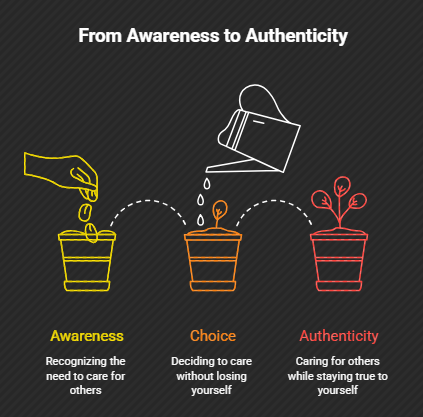
The goal is not to stop caring about others. The goal is to learn how to exist first, so that when we please others, it comes from choice, not from fear of losing acceptance.
At first glance, they seem connected. After all, isn’t pleasing people part of being kind?Isn’t adapting part of being a good friend, partner, colleague, or family member?
Yes. But there is a difference between choosing to care for others... and disappearing in order to be accepted. That difference changes everything. Because for many people with ADHD and other neurodivergent profiles, complacer didn’t start as kindness.
It started as survival.
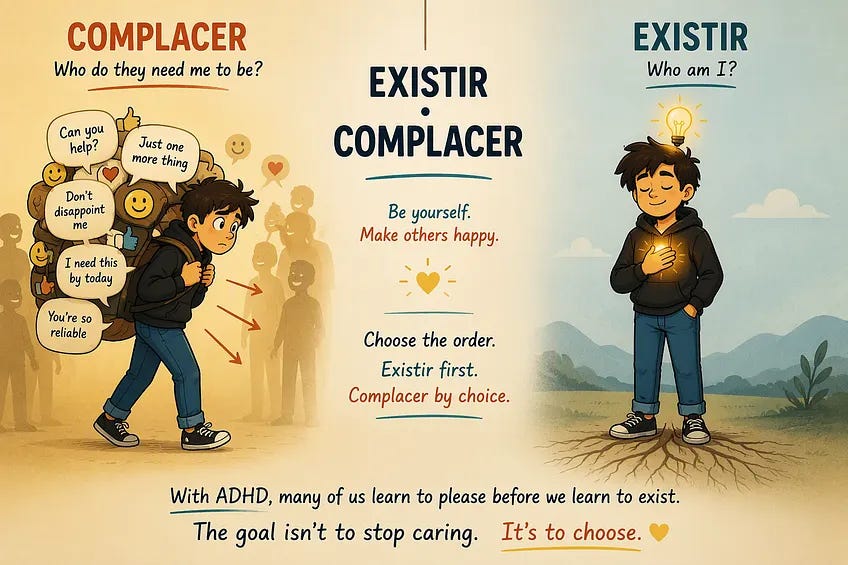
🎭 When pleasing others becomes a reflex
Many of us learned this pattern very early. Before we learned to ask: “What do I need?”
we learned to ask: “What does everyone else need from me?”
We became experts at reading the room. We noticed changes in people’s moods. We adjusted our behaviour. We tried to avoid disappointment.
We became: The easy child. The helpful colleague. The friend who always understands. The partner who adapts.
The person who says: “No problem.” Even when there is a problem.
For many ADHDers, this can become even stronger. Because growing up, many of us received messages, directly or indirectly, that something about us was wrong.
Too distracted. Too emotional. Too intense. Too forgetful. Too much. Not enough. So we started adapting. We started editing ourselves. We started wearing masks.
🎭 The funny one. 🎭 The one who always helps.
🎭 The one who never complains.🎭 The one who is “easy to work with.”
The mask works. Until it becomes difficult to know who is wearing it.
Three ways people pleasing appears in everyday life
👧 Childhood: becoming the “good kid”
Many children with ADHD learn early that being themselves creates friction.
Maybe they were:
too energetic
too emotional
too forgetful
too curious
too impulsive
They feel “too much“, so they adapt. They become the child who tries very hard not to cause problems. The child who thinks: “If I am good enough, maybe I won’t disappoint anyone.”
💼 Workplace masking
At work, people pleasing can look like success. You become reliable. Always available. Always willing. The person everyone goes to.
But inside: You are overwhelmed. Your priorities are disappearing. Your energy is gone. You are performing competence instead of creating sustainable ways of working.
🤍 Relationships and friendships
This is where it often hurts the most, because relationships should be where we can be ourselves. But many people pleasers struggle with:
expressing preferences
asking for support
setting boundaries
admitting exhaustion
saying no
They become experts at understanding others. But strangers to themselves.
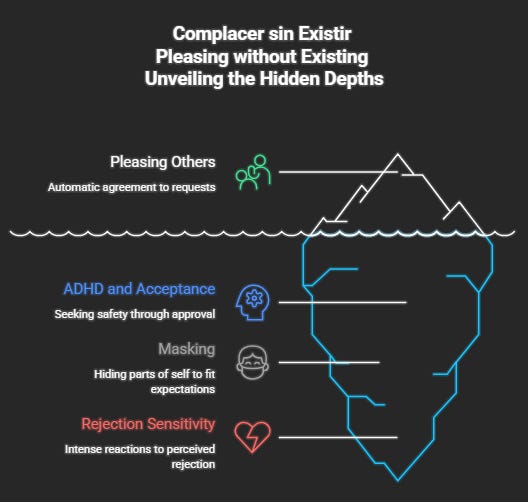
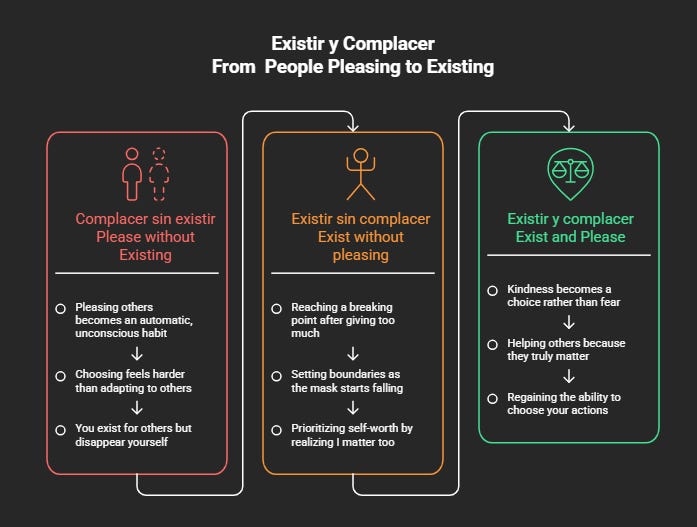
🌱 Complacer sin Existir or Pleasing without existing
This is the first step. The moment where pleasing others becomes automatic. You don’t even notice you’re doing it anymore.
Someone asks: “Can you help me?”
Your answer: “Of course.” Before your brain even checks: “Do I actually have the energy?”
A friend wants to meet. You are exhausted. But you go anyway.
A colleague asks for help. Your workload is already too high. But you say yes.
Your partner asks what you want to do. You answer: “Whatever you want.”
Not because you don’t have an opinion. But because choosing feels harder than adapting.
The hidden cost? You are present... but you are not fully there.
You exist for others. But you slowly disappear from yourself.
Why does this happen?
Understanding the reason matters. Because if you don’t understand the pattern, you only see the behaviour.
You think: “Why can’t I just say no?”, “Why do I always do this?”, “Why do I care so much about what people think?” But underneath, there is usually a deeper mechanism.
🧠 ADHD and the search for acceptance
ADHD affects more than attention. It also affects:
emotional regulation
impulse control
working memory
self-monitoring
awareness of internal needs
Many ADHDers spend years receiving negative feedback. Forgot something. Interrupted someone. Missed a deadline. Didn’t follow through. We’re “too much.” Over time, the brain can start looking for safety through approval.
“If people are happy with me, I am safe.” “If nobody is disappointed, I am okay.”
🎭 Masking: becoming someone easier to accept
Masking means hiding or changing parts of yourself to fit expectations.
It can look like:
rehearsing conversations before having them
copying other people’s behaviour
suppressing excitement
hiding confusion
pretending things are easier than they are
constantly monitoring yourself
Masking can help us navigate the world. But constantly performing is exhausting. Because eventually the question becomes:
“Who am I when nobody needs anything from me?”
💔 Rejection sensitivity and people pleasing
Many ADHDers experience intense emotional reactions to perceived rejection or criticism. Even a small signal can feel huge: A shorter message. A different tone of voice. Someone looking disappointed.
The brain quickly creates a story:
“They are upset with me.”, “I did something wrong.”, “I need to fix this.”
So we apologise. We explain. We over-help. We try to repair something that may not even be broken.
🌿The next step:
Existir sin Complacer OR Existing without pleasing
After years of giving too much, many people reach a breaking point.
They think: “I am done caring what people think.”
Boundaries appear. The mask starts falling.
This stage can be necessary. But it is not the final destination.
Because the goal isn’t becoming cold. The goal isn’t to stop caring.
The goal isn’t: “Nobody matters except me.”
The goal is: “I matter too.”
🌱 The Last step:
Existir y Complacer OR Existing and pleasing
This is the balance. The place where kindness becomes a choice.
You can help someone. You can compromise. You can put someone else’s needs before yours sometimes. But now it comes from freedom. Not fear.
There is a huge difference between: “I have to help because otherwise they won’t like me.”
and: “I want to help because this person matters to me.”
The action might look identical. But internally, everything has changed.
🔑 The real problem isn’t people pleasing
People often say: “You need to stop people pleasing.”
But that isn’t completely true. Caring about people is not a weakness. Being considerate is not a problem. Being generous is not something to remove.
The problem is when pleasing others becomes the price you pay to belong.
The problem is losing the ability to choose.
Because: People pleasing isn’t the problem. Not having a choice is.
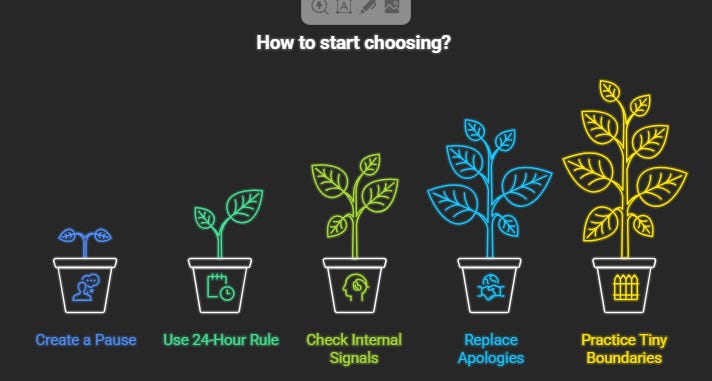
Practical ADHD strategies:
moving from automatic to intentional
⏸️ 1. Create a pause before saying yes
ADHD brains often respond quickly. Especially when approval is involved.Instead of answering immediately try: “Let me check and get back to you.”
A pause creates space between the request and the reaction.
That space is where choice lives.
⏳ 2. Use the 24-hour yes rule
For important commitments, don’t answer immediately. Give yourself time.
Ask:
Do I have the energy
Do I actually want this?
Am I saying yes because I care or because I fear disappointment?
🧭 3. Check your internal signals
Many ADHDers are better at reading others than themselves.
Practice asking: “What is happening inside me right now?”
Am I: Tired? Overwhelmed? Excited? Uncomfortable? Avoiding conflict?
Your body often answers before your brain does.
🪞 4. Replace automatic apologies
Instead of: “Sorry I’m late.” Try: “Thanks for waiting.”
Instead of: “Sorry for asking.” Try: “Thanks for helping me.”
Small language changes rebuild self-respect.
🌱 5. Practice tiny boundaries
You don’t start with huge boundaries, start small:
“I can’t today, but I can next week.” “I need some time to think.” “I prefer something else.”
Your brain learns: “I can disappoint someone and still be loved.”
🔄 Before & After
Sometimes healing isn’t about becoming someone different.
It’s about moving from automatic survival to intentional choice.
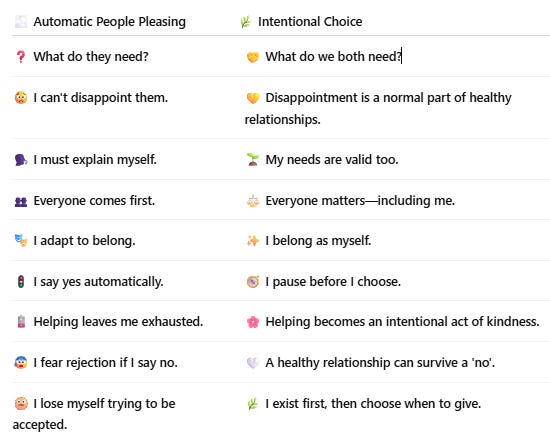
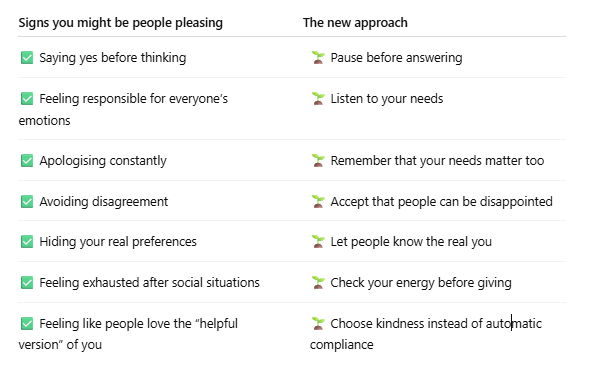
🌱 ADHD People Pleasing Cheat Sheet
Recognise the pattern → Choose a new response
Awareness leads to Choice and this finally leads to Authenticity. The goal is not to stop caring about others. The goal is to care without losing yourself. 🌱
🤍 Final thought
🌱 Existir and Complacer.
Two simple Spanish words and 2 completely different ways to live. For many of us with ADHD Complacer became a reflex.
🎭 Masking 🔄 Adapting 💭 Trying to be enough and too much!
We learned to read the room before we learned to listen to ourselves. But healing is not about choosing between yourself and others. It is about creating a choice.
🌱 Exist first 🤍 Please when you choose.
Because pleasing others should be an expression of who you are... not the price you pay to be accepted. The healthiest relationships don’t require you to disappear. They begin with someone who already exists. And from that place... kindness becomes a gift. Not a survival strategy.
💙 A Quick Note
Every Wednesday, I share a new ADHD Wisdom Tools article with practical strategies to help ADHD brains work with themselves instead of against themselves.
If today’s article made you think “That’s me!”, you’re in the right place.
See you next Wednesday. 🧠✨
🌱 And if this resonated with you...
💬 Comment: What part of this journey felt familiar to you?
↗️ Share: Someone else may need the reminder that they don’t have to disappear to be loved.
🌱 Subscribe to ADHD Wisdom Tools for more insights and practical strategies about ADHD, neurodivergence, authenticity and creating a life that works with your brain.
Remember
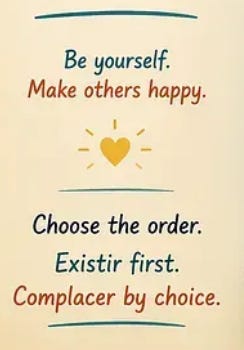
Choose the order
🌱 Exist first 🤍 Please when you choose
Excellent post!! I recognize myself in so much of this! I have done and continue to do the work of finding my place without losing my mind. Monitoring the room, pressing through until I hit the wall. So many people have NO idea.
People pleasing is so ingrained, sometimes not even recognized until looking back in time. Great post.